
Patch Prioritization: How to Rank Fixes by Real Risk
Patch prioritization replaces vulnerability counts with risk context, ensuring teams fix the issues that attackers can actually exploit before they run out of time or resources.
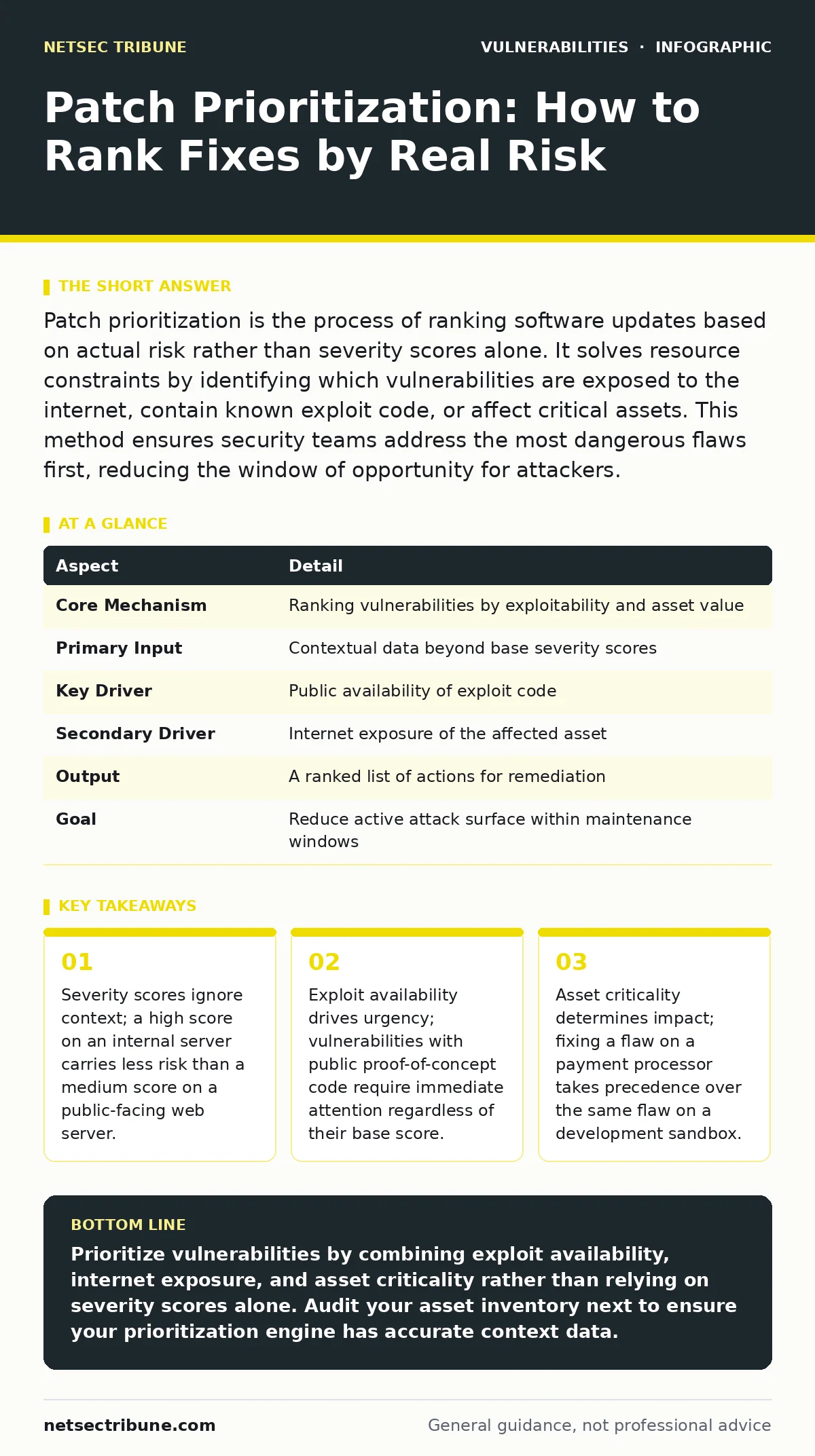
Patch prioritization is the process of ranking software updates based on actual risk rather than severity scores alone. It solves resource constraints by identifying which vulnerabilities are exposed to the internet, contain known exploit code, or affect critical assets. This method ensures security teams address the most dangerous flaws first, reducing the window of opportunity for attackers.
The Library Analogy for Risk
Imagine a library where every book has a hole in its cover. Some holes are small, some are large. A naive approach involves fixing every hole immediately, starting with the largest ones. A smarter approach asks where the book sits. A book on the open shelf near the door faces more wear than a book in the locked archive. You fix the exposed book first, even if its hole is smaller. Patch prioritization applies this logic to software. It moves the focus from the size of the flaw to the likelihood of it being used against you.
At a Glance: Prioritization Components
| Aspect | Detail |
|---|---|
| Core Mechanism | Ranking vulnerabilities by exploitability and asset value |
| Primary Input | Contextual data beyond base severity scores |
| Key Driver | Public availability of exploit code |
| Secondary Driver | Internet exposure of the affected asset |
| Output | A ranked list of actions for remediation |
| Goal | Reduce active attack surface within maintenance windows |
The Problem with Raw Severity Scores
Vendors assign severity scores to vulnerabilities using standardized frameworks. These scores measure the theoretical maximum impact of a flaw. They do not measure whether an attacker can reach the flaw. A system might have 500 vulnerabilities rated as critical. Fixing all 500 within a single maintenance window is impossible. Teams must choose which 20 to fix. If they choose based only on the highest numbers, they might ignore a medium-severity flaw on a public web server that already has working exploit code. This is the core problem prioritization solves. It introduces reality into the math.
The Three Pillars of Prioritization
Effective prioritization relies on three specific data points. You must combine them to get an accurate risk picture.
- Exploitability: Does code exist that allows an attacker to trigger this flaw? If a vulnerability has a public proof-of-concept script, the risk is immediate. Automated bots scan for these specific signatures.
- Exposure: Is the affected system accessible from the internet? Vulnerabilities on internal networks require an attacker to already be inside. Vulnerabilities on public-facing services require only a network connection. Exposure amplifies risk significantly.
- Asset Criticality: What does the system do? A flaw in a public-facing customer portal carries more business risk than the same flaw in an isolated logging server. You must map vulnerabilities to business functions.
Integration with Broader Defenses
Prioritization does not replace other security controls. It works alongside them to manage residual risk. You cannot patch everything instantly. Some systems must remain unpatched due to stability concerns or lack of vendor support. In these cases, you rely on other layers. Web application firewalls can block exploit traffic targeting known vulnerabilities. This buys time for a proper fix. Exposure management helps you identify which assets are visible to attackers in the first place. If you reduce exposure, you reduce the pool of prioritizable risks.
See also: Bug Bounty Triage Explained: How to Filter Noise From Real Threats
Common Misconceptions in Remediation
Many teams make predictable errors when building their prioritization logic. These errors create false confidence.
- Relying solely on base scores: Base scores ignore the environment. A high score on a system that no one uses is low risk. A low score on a system that processes payments is high risk.
- Ignoring CVSS environmental scores: Environmental scores allow you to adjust the base score based on your specific context. They account for factors like physical proximity and user interaction. Most teams leave these at default values, which provides no additional context.
- Assuming internal is safe: Internal networks are not immune. Attackers who gain a foothold move laterally. However, the initial effort to reach internal systems is higher. Prioritization should reflect this higher barrier to entry, but not ignore it entirely.
The Hidden Cost of Delayed Context
Prioritization requires data. You need accurate inventory of your assets. You need to know what software runs on them. You need to know where they are in the network. Many organizations lack this basic hygiene. They discover vulnerabilities faster than they can map their assets. This creates a bottleneck. You cannot prioritize what you cannot see. The hidden cost of poor prioritization is not just unpatched flaws. It is the wasted effort of patching low-risk items while high-risk items remain open. This drains team morale and budget.
Operationalizing the Process
You must automate the intake of contextual data. Manual prioritization does not scale. Integrate your vulnerability scanner with your asset management database. Tag assets by criticality. Feed this data into your prioritization engine. The engine should output a ranked list. Review this list weekly. Adjust weights as your business changes. If a system becomes more critical, its associated vulnerabilities should rise in priority. If you decommission a system, remove its vulnerabilities from the active list. This keeps the signal clear.
Linking to Continuous Security
Prioritization is not a one-time task. It is a continuous loop. As you patch, new vulnerabilities appear. As your infrastructure changes, exposure levels change. You must integrate this process into your broader security operations. For instance, when reviewing CI/CD pipeline vulnerabilities, prioritize those that allow unauthorized code execution in production. When assessing broken access control, prioritize flaws that expose sensitive data to unauthenticated users. These specific contexts change the urgency of the fix. You are not just fixing code. You are managing the attack surface.
The Role of Human Judgment
Automation provides the ranking. Humans provide the final decision. Sometimes, a low-ranked vulnerability requires immediate attention due to a specific business event. A major product launch may increase exposure. A regulatory audit may require specific fixes. The prioritization tool should flag these anomalies, but the security team must make the call. Trust the data, but verify the context. This balance ensures you address real risks without being blindsided by edge cases.
Key takeaways
- Severity scores ignore context; a high score on an internal server carries less risk than a medium score on a public-facing web server.
- Exploit availability drives urgency; vulnerabilities with public proof-of-concept code require immediate attention regardless of their base score.
- Asset criticality determines impact; fixing a flaw on a payment processor takes precedence over the same flaw on a development sandbox.
Prioritize vulnerabilities by combining exploit availability, internet exposure, and asset criticality rather than relying on severity scores alone. Audit your asset inventory next to ensure your prioritization engine has accurate context data.
Frequently asked questions
How does patch prioritization differ from vulnerability management?
Vulnerability management is the end-to-end process of finding and fixing flaws. Patch prioritization is the specific step within that process where you decide the order of fixes based on risk context.
Can I automate patch prioritization completely?
You can automate the data collection and ranking. You cannot fully automate the final decision. Business context and unique operational constraints require human judgment to validate the automated list.
What data sources are needed for accurate prioritization?
You need vulnerability scan results, asset inventory data, network exposure maps, and threat intelligence on exploit availability. Without all four, your risk model will be incomplete.
Does prioritization replace the need to patch everything?
No. Prioritization manages the order of operations. The goal is still to remediate all known vulnerabilities. It ensures you fix the most dangerous ones first while working toward total coverage.
How this guide was produced: written by the NetSec Tribune editorial team with AI assistance, checked against the public references listed below, and reviewed when the facts change. See our editorial policy or report an error.