CVSS Environmental Scores: Meaning, Definition and Practical Use
CVSS environmental scores adjust base severity ratings by factoring in specific deployment conditions, revealing risks that generic vulnerability databases consistently overlook.
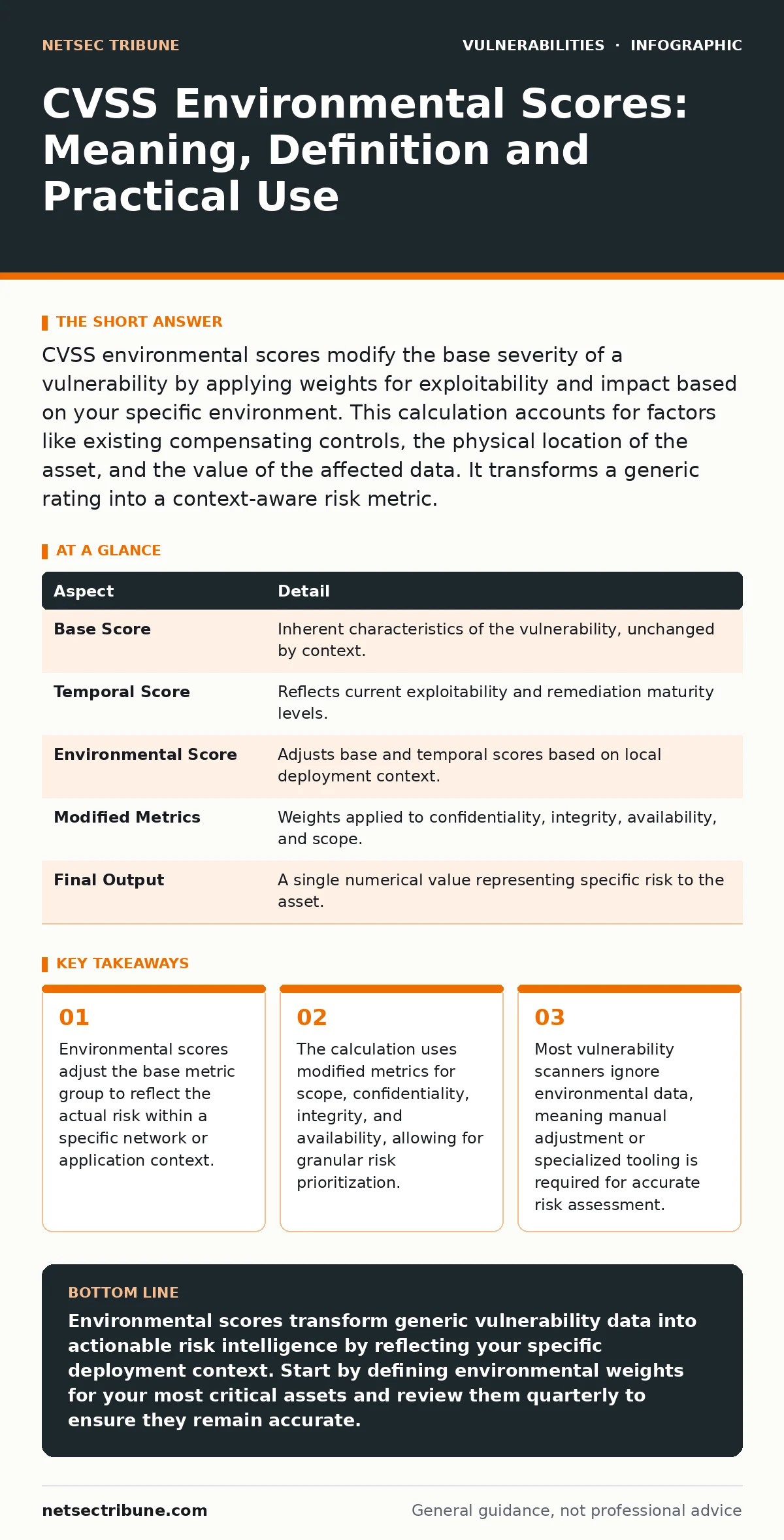
CVSS environmental scores modify the base severity of a vulnerability by applying weights for exploitability and impact based on your specific environment. This calculation accounts for factors like existing compensating controls, the physical location of the asset, and the value of the affected data. It transforms a generic rating into a context-aware risk metric.
The Pizza Delivery Analogy
Imagine a vulnerability is a delivery of cold pizza. The base score represents the pizza itself: a large pepperoni is inherently more valuable than a small cheese slice. This is the Base Score, which remains constant regardless of who receives it. The Temporal Score adjusts for how quickly the pizza arrives and whether the delivery driver is reliable.
This reflects the current state of exploit code and vendor patches. The Environmental Score accounts for the recipient. A hungry student values the pizza differently than a person on a strict diet. The environmental score adjusts the value based on the specific context of the receiver. It determines whether the pizza is actually useful or harmful in that specific situation.
Defining CVSS Environmental Scores
CVSS environmental scores represent the third vector group in the Common Vulnerability Scoring System. They modify the Base and Temporal scores by applying weights to specific metrics that reflect the unique characteristics of the user's environment. The system allows you to adjust for factors that the generic base score cannot know.
These factors include the presence of compensating controls, the physical proximity of the threat actor, and the specific data confidentiality requirements of the organization. The environmental score is not a separate rating. It is a calculated adjustment that produces a final score between 0.0 and 10.0. This final score reflects the actual risk to your specific infrastructure.
The calculation involves modifying four key metrics: Confidentiality, Integrity, Availability, and Scope. You assign a weight to each metric based on how critical that attribute is in your environment. For example, if an application handles financial data, you might increase the weight of Confidentiality. If it handles public marketing content, you might decrease it. The system then recalculates the impact metric using these weights. It also adjusts the exploitability metric based on the presence of mitigating controls. This process creates a score that is unique to your deployment.
| Aspect | Detail |
|---|---|
| Base Score | Inherent characteristics of the vulnerability, unchanged by context. |
| Temporal Score | Reflects current exploitability and remediation maturity levels. |
| Environmental Score | Adjusts base and temporal scores based on local deployment context. |
| Modified Metrics | Weights applied to confidentiality, integrity, availability, and scope. |
| Final Output | A single numerical value representing specific risk to the asset. |
Where the Term Comes From in Practice
The Common Vulnerability Scoring System originated as a standard for communicating the severity of software vulnerabilities. Early versions focused almost exclusively on the technical characteristics of the flaw. This approach assumed that a vulnerability was equally dangerous in every context. Security teams quickly realized this assumption was flawed.
A remote code execution flaw in a public-facing web server is far more dangerous than the same flaw in an isolated internal printer. The environmental vector group was introduced to address this gap. It allows organizations to map the generic vulnerability data to their specific risk model. This practice bridges the gap between technical discovery and business risk.
In daily operations, environmental scoring is rarely automatic. Most vulnerability scanners report Base or Temporal scores. They lack the context to know your business logic or your network segmentation. You must manually define the environmental parameters. This often involves integrating with configuration management databases or asset management systems. Some advanced platforms allow you to define environmental profiles. These profiles apply specific weights to different classes of assets. For instance, a database server might have a high confidentiality weight, while a web cache might have a high availability weight. This manual step is where most teams struggle.
How Environmental Scores Are Used Day to Day
Security teams use environmental scores to prioritize remediation efforts. Without this adjustment, teams often chase high base scores that pose minimal actual risk. Conversely, they may ignore lower base scores that exploit critical business logic. By applying environmental weights, you align technical severity with business impact. This helps you decide which patches to apply first. It also helps in communicating risk to stakeholders who care about business outcomes rather than technical details. The process requires consistent data about your environment. You need to know which assets exist, what data they hold, and what controls are in place.
Imagine a web application with a known broken access control vulnerability. The base score is high because it allows unauthorized data access. However, the application is behind a strict identity provider that enforces multi-factor authentication. This identity provider acts as a compensating control. In your environmental scoring, you reduce the modified exploitability metric to reflect this control.
You might also reduce the modified confidentiality impact if the application only displays non-sensitive data. The resulting environmental score drops significantly. This tells you that the immediate risk is low. You can schedule the fix for the next maintenance window rather than treating it as an emergency.
What People Usually Get Wrong
Many teams treat environmental scoring as a one-time configuration. They set weights once and never update them. This is a critical error. Your environment changes constantly. New compensating controls are deployed. Old ones are removed. The value of data changes as business priorities shift. A server that holds test data today might hold production data tomorrow. If your environmental weights do not reflect this change, your risk scores become misleading. Regular reviews of environmental parameters are necessary to maintain accuracy. This is often overlooked in favor of chasing new vulnerabilities.
Another common mistake is assuming that environmental scoring replaces other security practices. It does not. It is a prioritization tool, not a detection tool. It helps you decide what to fix first. It does not prevent the vulnerability from being exploited. You still need to monitor for attacks and apply patches. Some teams also confuse environmental scoring with exposure management. Exposure management focuses on identifying and reducing the attack surface. Environmental scoring assesses the risk of known vulnerabilities within that surface. Both are necessary, but they serve different purposes. One finds the doors; the other rates the risk of leaving them unlocked.
See also: Asset Inventory for Patching: Definition, Purpose, and Execution · CWE Weakness Categories: Practical Defense for Small Teams
The Hidden Cost of Manual Adjustment
The primary barrier to widespread adoption of environmental scoring is the effort required. Defining and maintaining environmental weights is labor-intensive. You need accurate data about your assets and controls. This data is often scattered across different systems. Gathering it requires integration and maintenance. Many organizations lack the resources to do this consistently. As a result, they rely on base scores, which are easier to obtain but less accurate. This creates a false sense of security. Teams believe they are prioritizing based on risk, but they are actually prioritizing based on generic technical severity. The hidden cost is the misallocation of security resources.
Consider the complexity of calculating modified scope. Scope changes when a vulnerability allows an attacker to affect components other than the vulnerable component. Determining whether scope changes requires a deep understanding of the application architecture. Most vulnerability scanners cannot determine this automatically. You must manually inspect the code or the configuration. This manual inspection is time-consuming. It requires skilled analysts who understand both the technology and the business context. Without this expertise, the environmental score is likely to be incorrect. This inaccuracy can lead to poor decision-making.
Integrating with Other Security Frameworks
Environmental scoring works best when integrated with other security frameworks. For example, understanding CWE weakness categories helps you identify the root cause of a vulnerability. This knowledge can inform your environmental weights. If a vulnerability stems from a common weakness that is hard to mitigate, you might increase the weight of exploitability. Similarly, exposure management provides data about which assets are visible to attackers. This data helps you adjust the modified attack vector metric. If an asset is not exposed, you can reduce the exploitability weight. This integration creates a more holistic view of risk.
Some teams also consider pre-authentication vulnerabilities differently in their environmental scoring. These vulnerabilities are dangerous because they do not require user interaction. In an environment with strict network segmentation, the risk might be lower. However, if the asset is internet-facing, the risk is high. The environmental score captures this nuance. It allows you to distinguish between a theoretical flaw and a practical threat. This distinction is vital for effective risk management. It ensures that your security efforts are focused on the vulnerabilities that matter most to your specific environment.
Key takeaways
- Environmental scores adjust the base metric group to reflect the actual risk within a specific network or application context.
- The calculation uses modified metrics for scope, confidentiality, integrity, and availability, allowing for granular risk prioritization.
- Most vulnerability scanners ignore environmental data, meaning manual adjustment or specialized tooling is required for accurate risk assessment.
Environmental scores transform generic vulnerability data into actionable risk intelligence by reflecting your specific deployment context. Start by defining environmental weights for your most critical assets and review them quarterly to ensure they remain accurate.
Frequently asked questions
How does CVSS version 3.1 differ from 2.0 in environmental scoring?
CVSS 3.1 introduces modified metrics for scope and changes how the impact metric is calculated, providing a more accurate reflection of complex attack scenarios.
Can I use environmental scores for compliance reporting?
Yes, many compliance frameworks require risk-based prioritization. Environmental scores provide a quantifiable metric for demonstrating due diligence in risk management.
What if I don't have data for all environmental metrics?
You can leave unspecified metrics at their default values. However, this reduces the accuracy of the score. Strive to fill in as much data as possible for critical assets.
Do all vulnerability scanners support environmental scoring?
No, most scanners only report base or temporal scores. You need specialized tooling or manual calculation to apply environmental weights and generate final scores.
How this guide was produced: written by the NetSec Tribune editorial team with AI assistance, checked against the public references listed below, and reviewed when the facts change. See our editorial policy or report an error.