CWE Weakness Categories: Practical Defense for Small Teams
Small teams must prioritize architectural flaws over code bugs because a single design error in access control bypasses all downstream security controls.
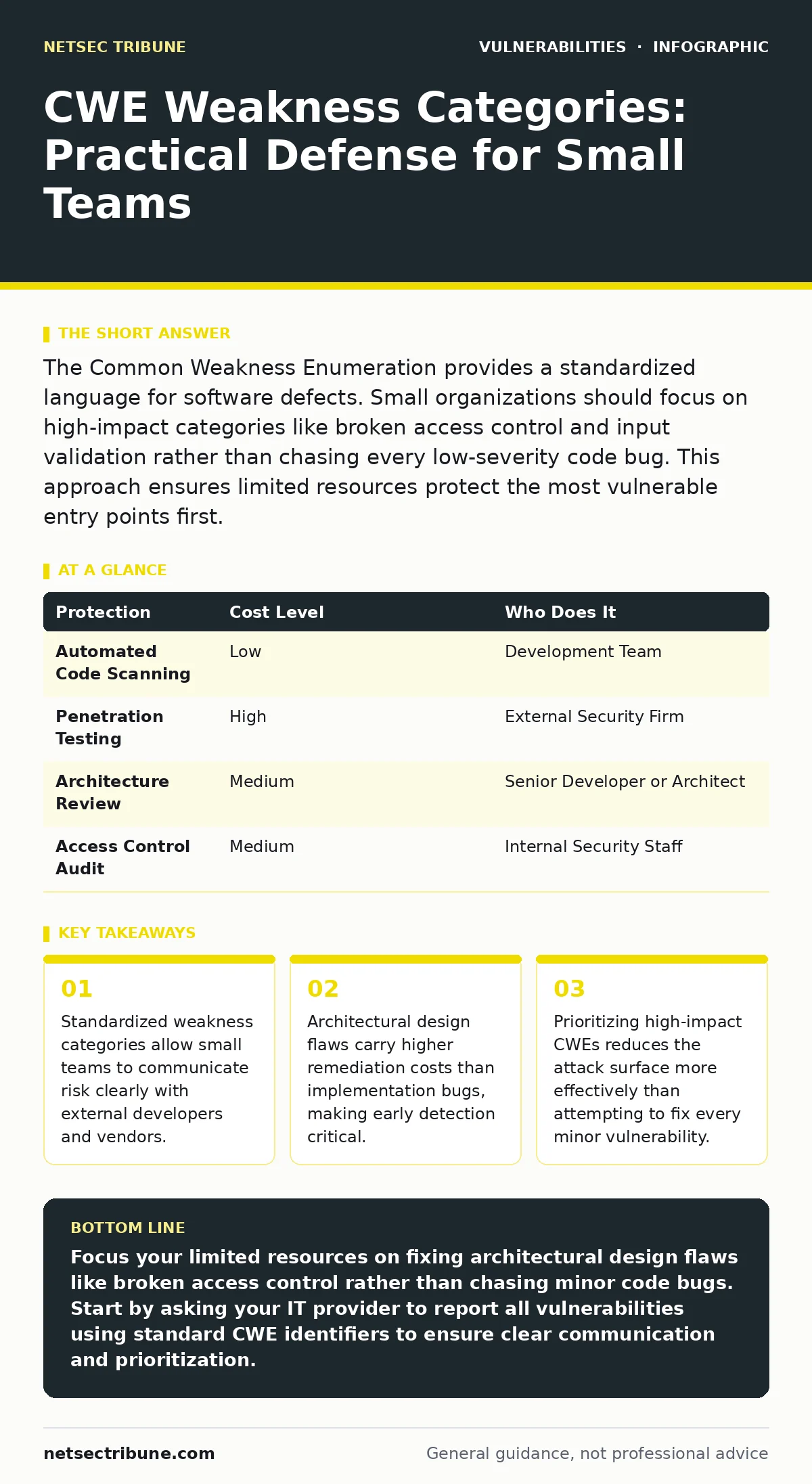
The Common Weakness Enumeration provides a standardized language for software defects. Small organizations should focus on high-impact categories like broken access control and input validation rather than chasing every low-severity code bug. This approach ensures limited resources protect the most vulnerable entry points first.
The Ten-Person Company Scenario
Imagine a small organization with limited technical staff. You likely rely on external developers or managed service providers for your core applications. The Common Weakness Enumeration (CWE) offers a structured way to understand software defects. It groups vulnerabilities by their root cause rather than their symptom. This classification helps you distinguish between a simple coding error and a fundamental design failure.
Small teams often feel overwhelmed by the volume of security alerts. Not all weaknesses carry equal risk. A memory corruption bug might require a complex chain of events to exploit. A broken access control flaw allows immediate data theft. Understanding these categories allows you to allocate your scarce resources to the threats that actually matter.
Why Classification Matters at Small Scale
The primary value of the CWE framework for small organizations is communication clarity. When you report a vulnerability to a vendor, using the correct CWE identifier removes ambiguity. It tells the developer exactly where the logic failed. This reduces back-and-forth questions and speeds up remediation.
Without this standard language, you might describe a problem as "users can see other people's data." The developer might interpret this as a display error. The correct classification, broken access control, indicates a missing authorization check. This distinction changes the fix from a cosmetic adjustment to a structural code change.
Standardization also helps you track recurring issues. If your applications repeatedly show input validation failures, you know the problem lies in your development process, not just in individual developers. You can then implement stricter code review practices or automated testing for that specific category.
Prioritizing High-Impact Weakness Categories
You cannot fix every vulnerability. You must prioritize based on impact and likelihood. The CWE database contains thousands of entries, but a small subset drives most serious breaches. Focus your efforts on architectural and design weaknesses first.
Broken access control remains one of the most prevalent and dangerous issues. It occurs when the application fails to restrict what a user can do. This is a design flaw, not a simple typo. Fixing it requires rethinking how permissions are enforced throughout the application.
Input validation failures are equally critical. These occur when the application trusts data from users without checking it. This leads to injection attacks where malicious code runs on your server. Proper input validation ensures that only expected data types and formats are accepted.
Mass assignment vulnerabilities offer another high-impact target. These happen when an application accepts more data than intended from a user request. An attacker can modify fields they should not touch, such as changing their account status to administrator. This is often an oversight in how data models are mapped to API endpoints.
Practical Implementation Steps
Start by mapping your critical assets to their underlying software components. Identify which applications handle sensitive data or financial transactions. These systems require the highest level of scrutiny.
Conduct a targeted review of these systems for the high-impact CWEs mentioned above. Do not attempt a full security audit of every minor feature. Focus on the core functions that interact with external users or sensitive databases.
Implement automated checks for common errors. Tools can scan your code for known patterns of input validation failures or mass assignment risks. This provides a baseline level of protection without requiring constant manual review.
Working with IT Providers
Small teams often outsource development and maintenance. You must ensure your provider understands the CWE framework. Ask them to report vulnerabilities using standard identifiers. This allows you to compare risks across different vendors and projects.
Request a breakdown of findings by CWE category. This helps you identify systemic issues. If a provider consistently delivers code with broken access control, you may need to change your contract or your provider.
Do not accept vague reports. A report stating "security issue found" is useless. A report stating "CWE-285: Improper Authorization" gives you actionable data. It tells you exactly what mechanism failed and where.
| Protection | Cost Level | Who Does It |
|---|---|---|
| Automated Code Scanning | Low | Development Team |
| Penetration Testing | High | External Security Firm |
| Architecture Review | Medium | Senior Developer or Architect |
| Access Control Audit | Medium | Internal Security Staff |
See also: Asset Inventory for Patching: Definition, Purpose, and Execution · CVSS Environmental Scores: Meaning, Definition and Practical Use
Questions to Ask Your Provider
You need to verify that your provider follows secure development practices. Ask these specific questions during your engagement.
- How do you integrate security testing into your development lifecycle?
- Can you provide a report of vulnerabilities using CWE identifiers?
- What is your process for fixing high-severity design flaws like broken access control?
- Do you perform regular reviews of access control logic and permission models?
- How do you handle input validation for all user-supplied data?
Avoiding Common Pitfalls
Do not focus solely on code-level bugs. Memory corruption bugs are serious, but they are often harder to exploit than logical errors. A small team should prioritize fixing the logic that controls user access and data flow.
Do not ignore web application firewalls entirely. While they do not fix the underlying code, they can block common attack patterns. They provide a temporary layer of defense while you work on permanent fixes.
Avoid the trap of chasing zero-day vulnerabilities. These are rare and often targeted at large organizations. Focus on known, common weaknesses that attackers use in automated scans.
Long-Term Strategy
Security is a continuous process, not a one-time project. Regularly review your application architecture for new risks. As you add features, you introduce new potential weaknesses.
Train your developers on the most common CWEs relevant to your stack. This shifts security left, catching issues earlier in the development cycle.
Maintain a record of past vulnerabilities and their fixes. This helps you identify trends and prevent recurring issues. It also provides evidence of due diligence in case of an incident.
Key takeaways
- Standardized weakness categories allow small teams to communicate risk clearly with external developers and vendors.
- Architectural design flaws carry higher remediation costs than implementation bugs, making early detection critical.
- Prioritizing high-impact CWEs reduces the attack surface more effectively than attempting to fix every minor vulnerability.
Focus your limited resources on fixing architectural design flaws like broken access control rather than chasing minor code bugs. Start by asking your IT provider to report all vulnerabilities using standard CWE identifiers to ensure clear communication and prioritization.
Frequently asked questions
How do I know which CWEs are most relevant to my application?
Review the type of data your application handles and the technologies used. Web applications should prioritize input validation and access control, while desktop apps may need to focus on memory safety.
Can automated tools find all CWE categories?
No. Automated tools are good at finding code-level bugs like input validation errors. They often miss architectural flaws like broken access control, which require manual review and logical analysis.
Is the CWE framework free to use?
Yes. The Common Weakness Enumeration is a public framework maintained by the community. You can use it freely to classify and communicate vulnerabilities without any licensing fees.
How often should I review my application for CWEs?
You should review your application every time you make significant changes or add new features. Regular quarterly reviews help catch drift in security practices and new vulnerabilities introduced by updates.
How this guide was produced: written by the NetSec Tribune editorial team with AI assistance, checked against the public references listed below, and reviewed when the facts change. See our editorial policy or report an error.