
How Crypto-Malware Works: A Step-by-Step Breakdown
Crypto-stealers bypass traditional defenses by mapping the file system for wallet data rather than exploiting cryptographic keys directly, turning local storage into the primary attack surface.
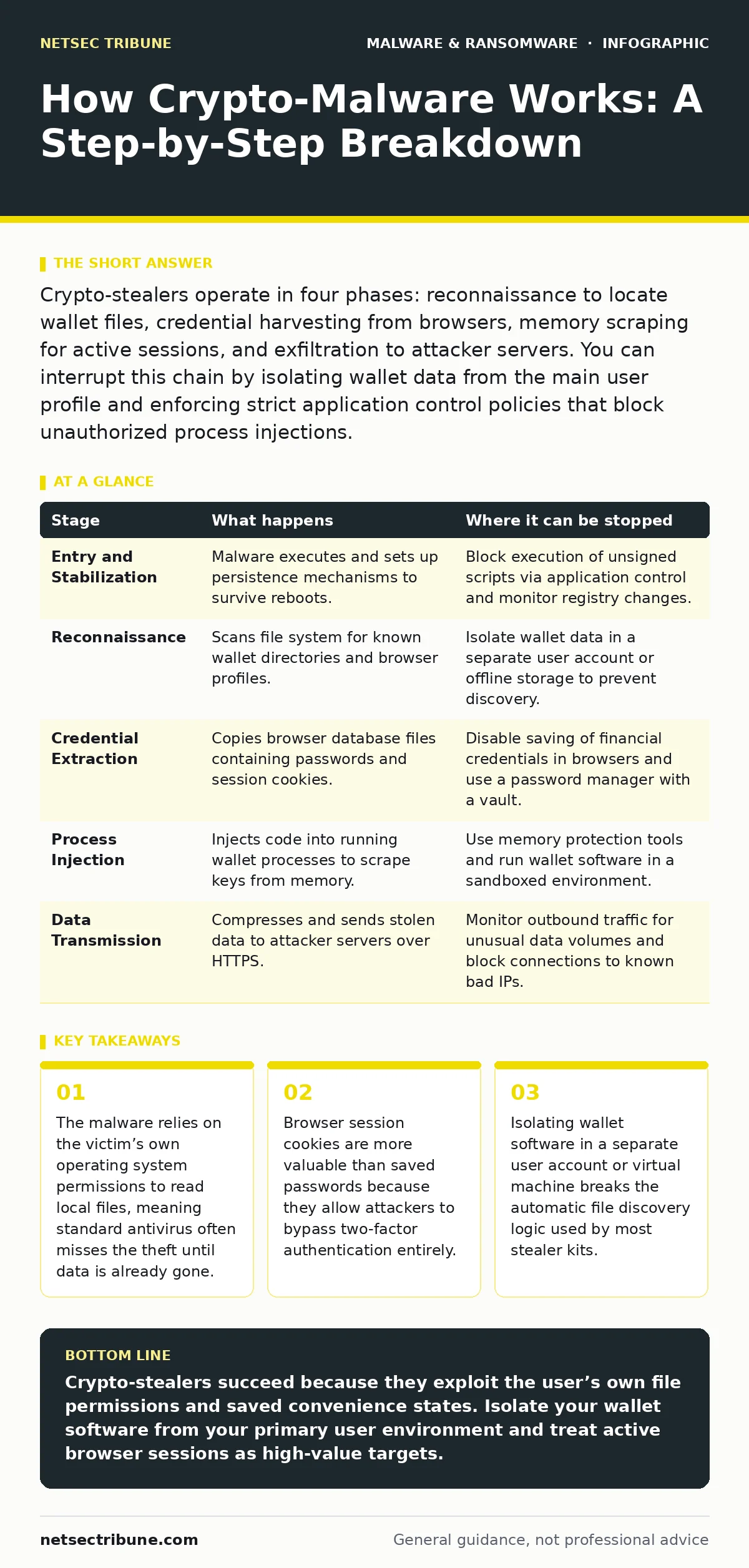
Crypto-stealers operate in four phases: reconnaissance to locate wallet files, credential harvesting from browsers, memory scraping for active sessions, and exfiltration to attacker servers. You can interrupt this chain by isolating wallet data from the main user profile and enforcing strict application control policies that block unauthorized process injections.
The Anatomy of a Digital Pickpocket
Crypto-stealing malware does not typically break encryption. Instead, it acts as a sophisticated file thief. It assumes that if you have downloaded a wallet application or used a browser to access an exchange, the necessary data already exists on your hard drive. The attacker’s goal is not to crack a mathematical problem but to copy specific files and memory states before you notice the intrusion.
This approach relies on the principle of least privilege being violated at the user level. When you run software, it inherits your permissions. If your user account can read your wallet files, the malware running under that same account can too. This makes the initial compromise vector less important than the post-exploitation behavior.
Initial Access and Persistence
Stage 1: Entry and Stabilization
The malware first enters the system through a vector such as trojanized software or a malicious PyPI package. Once executed, it does not immediately steal data. It first ensures it will survive a system reboot. It modifies registry keys or creates scheduled tasks to run automatically.
This stage is often silent. The malware checks for virtualization environments. If it detects a sandbox evasion technique, it may pause execution or behave normally to avoid analysis. It relies on the fact that most security tools scan files on disk, not behavior in memory, during the initial hours of infection.
Mapping the Asset Inventory
Stage 2: Reconnaissance and Discovery
The malware begins scanning the file system. It looks for known directories associated with popular wallet providers, browser profiles, and cryptocurrency exchange clients. It does not need to know your specific setup; it guesses based on common default installation paths.
It creates a list of targets. This includes local storage files for hardware wallet managers, seed phrase text files, and browser profile folders. The malware is not intelligent about your unique file naming conventions. It relies on the predictability of software developers who install files in standard locations.
Harvesting Browser Credentials
Stage 3: Credential Extraction
Browsers are a primary target because they cache sensitive data. The malware locates the browser’s local database files, which store saved passwords and, more critically, session cookies. It copies these files to a temporary directory.
Session cookies are the key here. They prove you have already authenticated. With a valid cookie, the attacker can access your exchange account without needing your password or two-factor authentication code. This is why changing your password is insufficient if the cookie has been stolen. The attacker remains logged in until the session expires or you explicitly log out from all devices.
Scraping Active Memory
Stage 4: Process Injection and Scraping
Static files are not enough if your wallet is encrypted with a strong passphrase. The malware looks for running processes. It injects code into the memory space of wallet applications or browser instances. This allows it to read data that is only present in RAM.
It searches for patterns that resemble private keys or decrypted seed phrases. This is a race against time. The data exists in memory only while the application is open. The malware must act quickly before the process closes or the data is overwritten. This technique bypasses file-level encryption because the data must be decrypted to be used by the application.
See also: Software Restriction Policies: 6 Common Misunderstandings · Decoding Ransom Notes: Evidence Handling and Negotiation Realities
Exfiltration and Cleanup
Stage 5: Data Transmission
Once the malware has collected files and memory dumps, it compresses them. It often adds a layer of encryption to protect the payload from network monitoring tools. It then sends this package to a command and control server.
The malware may also check for anti-debugging measures. If it detects that a security researcher is analyzing it, it might destroy the collected data or terminate itself. This is a defensive mechanism for the attacker, ensuring that their tooling remains hidden. The transmission often happens over standard HTTPS ports, blending in with normal web traffic.
Interrupting the Chain
You can stop this process at multiple stages. The most effective method is separation of duties. Run your wallet software in a separate user account with no network access, or use a dedicated virtual machine. This prevents the malware from finding the wallet files during the reconnaissance stage.
Application control policies can block the execution of unknown scripts or the injection of code into legitimate processes. This stops the memory scraping phase. Finally, regular rotation of browser sessions and disabling saved logins for financial accounts removes the value of the stolen cookies.
| Stage | What happens | Where it can be stopped |
|---|---|---|
| Entry and Stabilization | Malware executes and sets up persistence mechanisms to survive reboots. | Block execution of unsigned scripts via application control and monitor registry changes. |
| Reconnaissance | Scans file system for known wallet directories and browser profiles. | Isolate wallet data in a separate user account or offline storage to prevent discovery. |
| Credential Extraction | Copies browser database files containing passwords and session cookies. | Disable saving of financial credentials in browsers and use a password manager with a vault. |
| Process Injection | Injects code into running wallet processes to scrape keys from memory. | Use memory protection tools and run wallet software in a sandboxed environment. |
| Data Transmission | Compresses and sends stolen data to attacker servers over HTTPS. | Monitor outbound traffic for unusual data volumes and block connections to known bad IPs. |
The Hidden Cost of Convenience
The convenience of saving login states and installing wallet software on your primary machine creates a single point of failure. The malware does not need to be polymorphic malware to be effective. It only needs to follow a predictable script. The vulnerability is not in the code of the wallet or the browser, but in the configuration of your user environment.
By keeping financial tools isolated from general-use software, you remove the easy targets. The malware will still infect your system, but it will find no wallet files to steal and no active sessions to hijack. This is the difference between a successful theft and a failed attempt.
Related Considerations
Understanding this process helps in evaluating other threats. For instance, ransomware backups are often ignored because users focus on the encryption aspect. However, if a stealer has already copied your wallet files, restoring from backup does not secure your assets. You must revoke access and move funds to a new wallet.
Similarly, the rise of malicious mobile apps shows that this behavior is not limited to desktop operating systems. Mobile stealers also target SMS codes and browser cookies. The principles of isolation and monitoring apply across platforms.
Key takeaways
- The malware relies on the victim’s own operating system permissions to read local files, meaning standard antivirus often misses the theft until data is already gone.
- Browser session cookies are more valuable than saved passwords because they allow attackers to bypass two-factor authentication entirely.
- Isolating wallet software in a separate user account or virtual machine breaks the automatic file discovery logic used by most stealer kits.
Crypto-stealers succeed because they exploit the user’s own file permissions and saved convenience states. Isolate your wallet software from your primary user environment and treat active browser sessions as high-value targets.
Frequently asked questions
Does changing my password stop a crypto-stealer?
No, if the attacker has stolen your session cookies, they can still access your account without a password. You must revoke all active sessions.
Can antivirus software detect crypto-stealers?
Traditional antivirus often misses them because they behave like normal file copy operations until the exfiltration phase, which may look like standard web traffic.
Is using a hardware wallet safe from this malware?
Hardware wallets keep keys offline, but if the malware steals your browser session or access code for a companion app, it can still authorize transactions on your behalf.
How do I know if my wallet files were stolen?
You usually cannot tell immediately. Monitor your accounts for unexpected transactions or login attempts from new devices.
How this guide was produced: written by the NetSec Tribune editorial team with AI assistance, checked against the public references listed below, and reviewed when the facts change. See our editorial policy or report an error.