
Trojanized Software: Detection, Persistence, and Supply Chain Risks
Compromised legitimate binaries bypass signature-based defenses by retaining their original cryptographic signatures and file hashes until execution triggers the hidden payload.
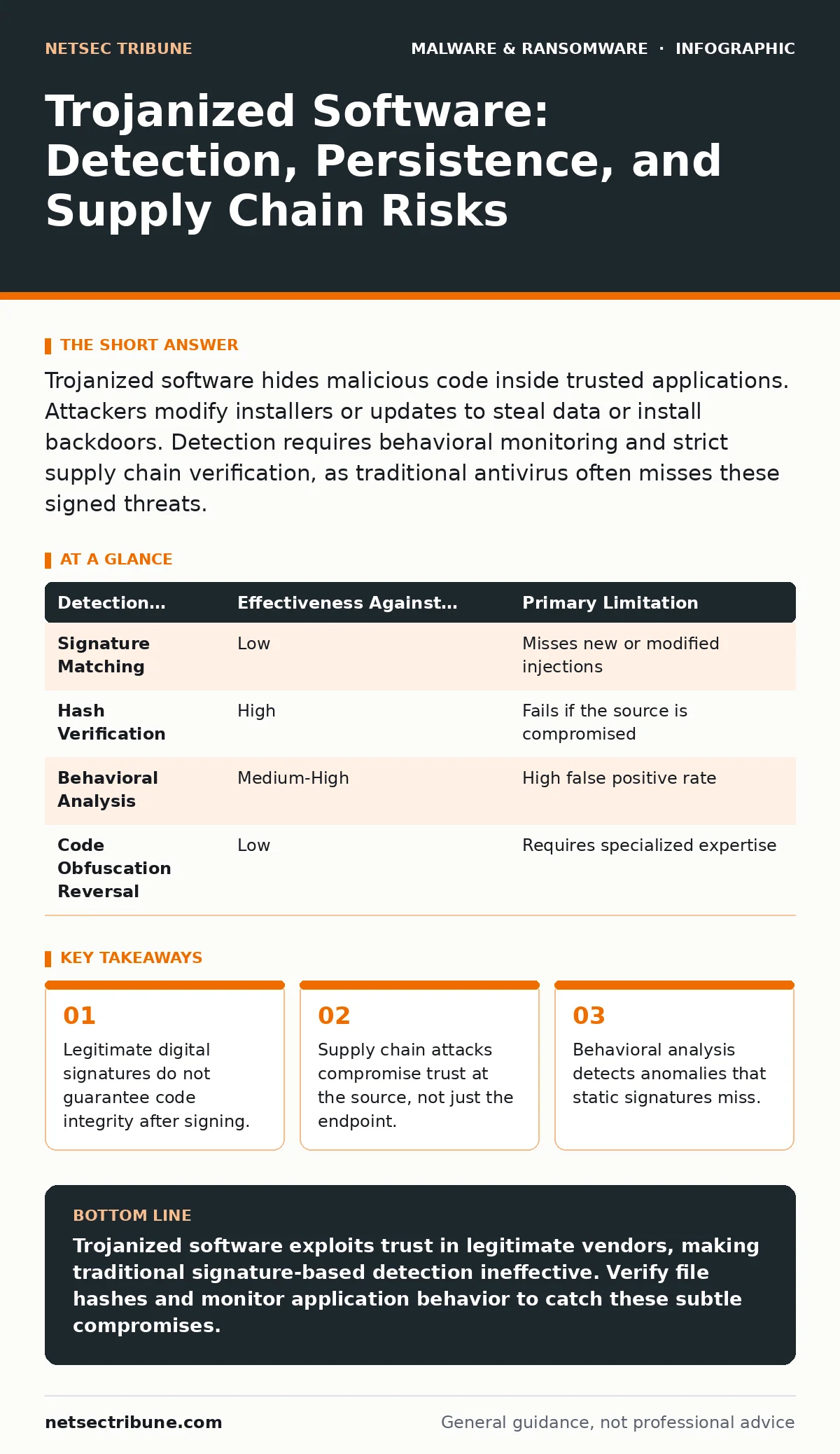
Trojanized software hides malicious code inside trusted applications. Attackers modify installers or updates to steal data or install backdoors. Detection requires behavioral monitoring and strict supply chain verification, as traditional antivirus often misses these signed threats.
What exactly is trojanized software?
Trojanized software is a legitimate application that has been modified to include malicious functionality while retaining its original appearance and primary function. The attacker does not replace the entire program but injects code that executes alongside the intended features. This distingu it from a pure trojan, which pretends to be something it is not.
How does it differ from standard malware?
Standard malware is created entirely by the attacker and lacks the legitimacy of the host application. Trojanized software leverages the trust users place in established vendors and popular tools. Because the core functionality works as expected, users are less likely to suspect foul play until data exfiltration or system compromise occurs.
Why do antivirus scanners often miss these threats?
Most traditional antivirus engines rely on signature matching, which compares file hashes against a database of known bad files. If the original developer signs the binary with a valid certificate, the hash remains valid for the legitimate portions. The malicious injection may be small or encrypted, causing the scanner to see only the trusted, signed code. This is why understanding sandboxing limitations is relevant, as static analysis fails here.
Can a digitally signed file still be dangerous?
Yes, a digital signature only proves the identity of the signer and the integrity of the file at the moment of signing. It does not prevent subsequent modification if the signing key is compromised or if the attacker injects code before the signature is applied in a build pipeline. Attackers often target the build environment to sign the trojanized version, making it appear fully legitimate to operating systems and security tools.
How do attackers insert the malicious code?
Attackers typically compromise the software build pipeline or intercept updates in transit. They modify the installer or the update package to include a secondary payload. This payload might establish a reverse shell, log keystrokes, or harvest credentials. The technique mirrors how crypto-stealing malware operates, though the vector is the trusted application itself rather than a phishing link.
See also: Software Restriction Policies: 6 Common Misunderstandings · Decoding Ransom Notes: Evidence Handling and Negotiation Realities
What is the supply chain attack vector?
A supply chain attack occurs when an attacker compromises a trusted third-party software provider to distribute malware to their customers. By trojanizing a widely used tool, the attacker gains access to thousands of downstream organizations simultaneously. This approach bypasses perimeter defenses because the traffic originates from a known, trusted source. You should review malicious PyPI packages strategies, as open-source ecosystems face similar risks.
How can you detect trojanized applications?
Detection requires moving beyond static signatures to behavioral monitoring. You must observe how the application interacts with the system after installation. Look for unexpected network connections, file system modifications, or privilege escalation attempts. Tamper protection mechanisms can alert you if a signed binary is altered on disk, but they cannot prevent the initial download of a pre-trojanized file.
What are the signs of a compromised update?
A compromised update often exhibits slight deviations in expected behavior, such as longer download times or unusual file sizes. More tellingly, the application may attempt to communicate with unknown external domains. Network traffic analysis can reveal these anomalies, especially if the application suddenly starts sending data to IP addresses not associated with its vendor. This is similar to how polymorphic malware changes its code to avoid detection, but here the structure is the update itself.
How do you verify software integrity before installation?
You must verify the cryptographic hash of the downloaded file against the vendor’s official publication. If the hash matches, the file has not been altered since signing. However, this only works if you trust the vendor’s website and signing key. Implementing ransomware backups is irrelevant here, as the threat is not data encryption but unauthorized access and data theft.
What is the role of application allowlisting?
Application allowlisting restricts execution to a predefined set of trusted binaries. This prevents trojanized software from running if it is not on the approved list. However, if the trojanized version retains the same filename and path as the legitimate version, allowlisting alone is insufficient. You must combine allowlisting with hash verification to ensure the specific file version is the one you expect.
| Detection Method | Effectiveness Against Trojanized Software | Primary Limitation |
|---|---|---|
| Signature Matching | Low | Misses new or modified injections |
| Hash Verification | High | Fails if the source is compromised |
| Behavioral Analysis | Medium-High | High false positive rate |
| Code Obfuscation Reversal | Low | Requires specialized expertise |
How does this relate to other malware types?
Trojanized software often serves as the delivery mechanism for other threats. Once inside, it may deploy keyloggers to capture credentials or computer worms to spread laterally across the network. The initial trust gained through the legitimate application makes these secondary payloads harder to detect and remove.
What is the long-term risk of a trojanized dependency?
If the trojanized software is a library or dependency used by other applications, the risk propagates through your entire software stack. Each application that calls the compromised library inherits the vulnerability. This creates a hidden backdoor that persists even if you patch the primary application, requiring a complete audit of dependent components.
How do you remediate a confirmed infection?
Remediation requires isolating the affected systems to prevent data exfiltration. You must identify all instances of the compromised binary and replace them with verified clean versions from the original source. Audit logs should be reviewed to determine what data was accessed or modified during the infection window. This process is complex because the malicious code may have established persistence mechanisms that survive simple file deletion.
Key takeaways
- Legitimate digital signatures do not guarantee code integrity after signing.
- Supply chain attacks compromise trust at the source, not just the endpoint.
- Behavioral analysis detects anomalies that static signatures miss.
Trojanized software exploits trust in legitimate vendors, making traditional signature-based detection ineffective. Verify file hashes and monitor application behavior to catch these subtle compromises.
Frequently asked questions
Can a trojanized app be cleaned without reinstalling?
No, because the malicious code is integrated into the binary. You must replace the file with a verified clean version from the trusted source.
Does updating the antivirus fix the issue?
Updating signatures may help if the specific variant is known, but behavioral monitoring is required for new or custom trojanized payloads.
Are open-source projects more vulnerable?
Open-source projects can be vulnerable if the build pipeline is compromised, but their transparency allows for community verification of source code integrity.
How do I know if my signing key is compromised?
Monitor for unexpected code changes or unauthorized builds. If you suspect compromise, revoke the key immediately and re-sign all releases.
How this guide was produced: written by the NetSec Tribune editorial team with AI assistance, checked against the public references listed below, and reviewed when the facts change. See our editorial policy or report an error.