
Why is spyware a problem: The hidden costs of silent surveillance
Spyware degrades system performance and leaks credentials before any ransom demand appears, creating a persistent blind spot in standard security monitoring.
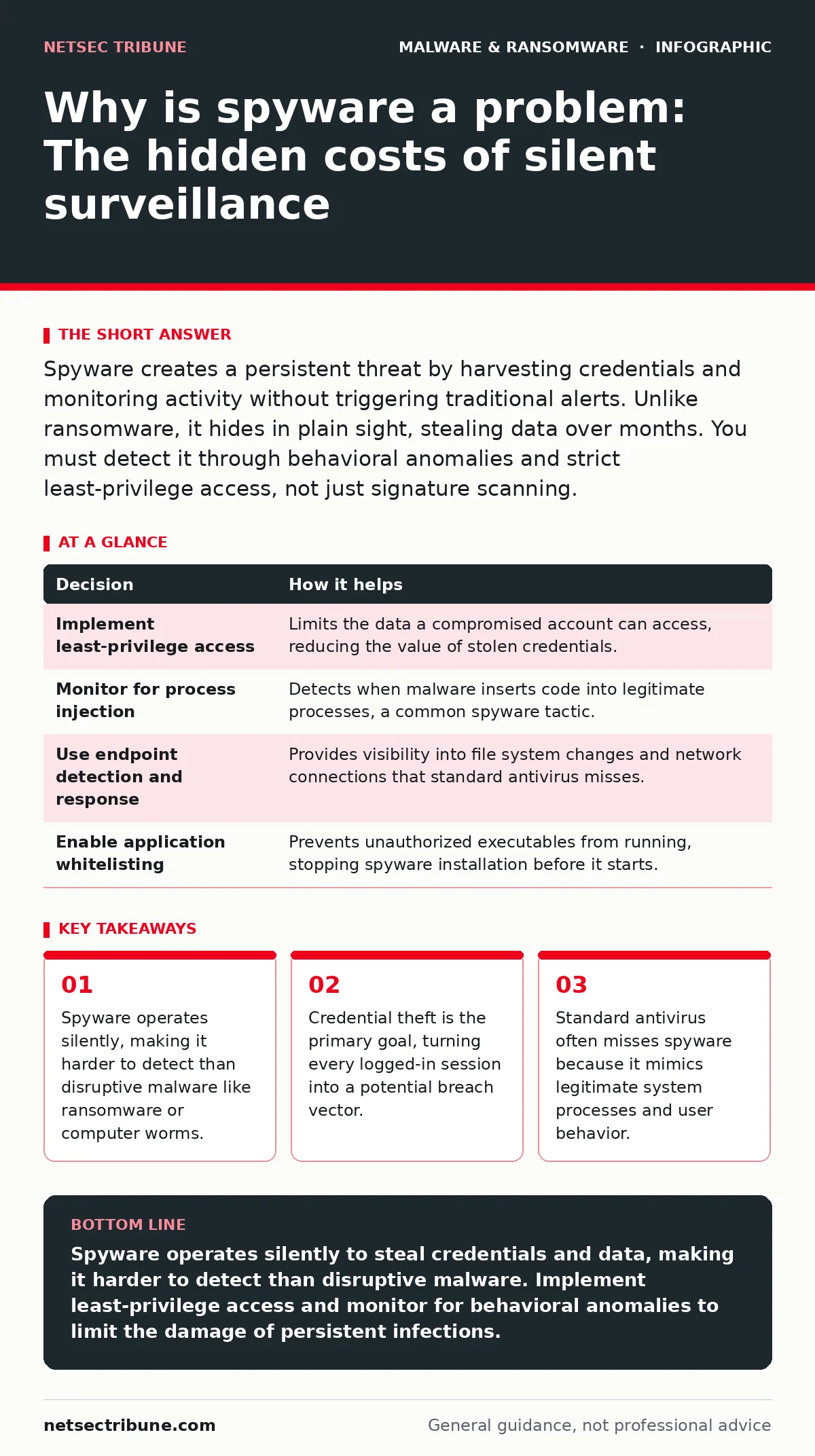
Spyware creates a persistent threat by harvesting credentials and monitoring activity without triggering traditional alerts. Unlike ransomware, it hides in plain sight, stealing data over months. You must detect it through behavioral anomalies and strict least-privilege access, not just signature scanning.
Why is spyware a problem for operational security
Spyware creates a problem because it prioritizes persistence and stealth over immediate disruption. Unlike ransomware that encrypts files and demands payment, spyware sits quietly in the background. It records keystrokes, captures screenshots, and logs network traffic. This silent operation allows attackers to gather high-value intelligence over extended periods. Security teams often miss these infections because they do not trigger loud alerts. The threat model shifts from stopping an attack to finding a hidden presence that has already succeeded in its primary objective.
The core issue is the asymmetry of detection. Attackers only need to hide one process, while defenders must monitor thousands. Spyware exploits this by masquerading as legitimate system utilities. It uses valid digital signatures or injects code into trusted applications. This technique, known as process hollowing, makes the malicious activity look like normal operating system behavior. Your standard security tools may report the system as healthy while sensitive data streams out to external servers.
The mechanics of silent data exfiltration
Spyware relies on covert channels to move stolen data. These channels often blend in with normal web traffic. Attackers use encrypted HTTPS connections that look identical to legitimate browsing activity. They may fragment data into small packets to avoid triggering volume-based alerts. Some variants use DNS tunneling, encoding stolen information within domain name requests. This method bypasses firewalls that only inspect standard ports.
Keyloggers are a common component of spyware kits. These tools record every keystroke entered on the device. They capture passwords, credit card numbers, and private messages. Modern keyloggers operate at the kernel level, making them difficult to remove without reinstalling the operating system. They do not just steal passwords; they steal the context of how those passwords are used. This includes session tokens and multi-factor authentication codes displayed on screen.
Credential theft and the failure of perimeter defenses
Perimeter defenses assume that once a user logs in, the session is safe. Spyware breaks this assumption by stealing active sessions. It captures session cookies and authentication tokens directly from the browser memory. With these tokens, attackers can bypass password requirements entirely. They gain immediate access to accounts without triggering login alerts. This makes account takeover nearly invisible to standard intrusion detection systems.
The impact extends beyond simple password theft. Spyware can intercept two-factor authentication codes as they appear on the screen. This defeats the security layer designed to stop credential stuffing attacks. Once the attacker has the token, they appear as the legitimate user. All subsequent actions, including data exports or permission changes, look like normal user behavior. The organization loses the ability to distinguish between a compromised user and a malicious insider.
Performance degradation and resource consumption
Spyware consumes system resources to maintain its persistence and exfiltrate data. This consumption leads to subtle performance degradation. Applications may load slower, and battery life on mobile devices decreases rapidly. Users often attribute these symptoms to aging hardware or software updates. They rarely suspect malicious software. This misattribution delays detection and allows the spyware to operate unchecked for longer periods.
The resource cost also includes network bandwidth. Continuous data exfiltration uses upload capacity. In enterprise environments, this can interfere with critical business applications. Large file transfers may fail or timeout due to the bandwidth hogging by the spyware. Network monitoring tools may flag this as unusual outbound traffic, but without context, it is often dismissed as a user error or a misconfigured application.
Detection challenges in modern environments
Traditional antivirus software struggles with spyware because it relies on known signatures. Spyware variants change their code frequently to avoid these signatures. They use polymorphic code that alters its appearance while keeping the same function. This means a new variant can bypass detection even if the previous one was identified. Relying solely on signature-based protection leaves a significant gap in your defense strategy.
Behavioral analysis is more effective but produces more false positives. Legitimate applications also perform actions that look suspicious, such as accessing the clipboard or recording the screen. Distinguishing between a legitimate video conferencing tool and a spyware screen recorder is difficult. Security teams must tune their detection rules carefully. Overly sensitive rules create alert fatigue, causing staff to ignore genuine threats. Under-sensitive rules allow spyware to operate freely.
| Decision | How it helps |
|---|---|
| Implement least-privilege access | Limits the data a compromised account can access, reducing the value of stolen credentials. |
| Monitor for process injection | Detects when malware inserts code into legitimate processes, a common spyware tactic. |
| Use endpoint detection and response | Provides visibility into file system changes and network connections that standard antivirus misses. |
| Enable application whitelisting | Prevents unauthorized executables from running, stopping spyware installation before it starts. |
See also: Remote Access Trojan Warning Signs and Immediate Response Steps
The role of trojanized software in distribution
Spyware often arrives through trojanized software. This occurs when attackers inject malicious code into legitimate applications. Users download the software expecting a useful tool, but they also install the spyware. This method exploits user trust and bypasses many security checks. The software appears to function normally, so users do not suspect foul play. This distribution method is particularly effective because it targets users who are already seeking specific functionality.
Open-source software repositories are common targets for this tactic. Attackers upload compromised versions of popular libraries or tools. When developers integrate these libraries into their projects, the spyware spreads to their systems. This supply chain attack vector is hard to trace. The malicious code is buried deep within the application dependencies, making it difficult to identify the source of the infection.
Mitigation strategies for persistent threats
Mitigating spyware requires a shift from prevention to detection and containment. You must assume that some spyware will bypass your initial defenses. Focus on limiting the damage it can cause. Implement strict least-privilege access controls. Ensure that standard users cannot install software or modify system settings. This reduces the attack surface available to the spyware.
Regularly audit user permissions and access logs. Look for unusual access patterns, such as a user accessing files they never touched before. Monitor network traffic for unexpected connections to unknown domains. Use sandboxing to isolate untrusted applications. This prevents spyware from affecting the main operating system. Combine these measures with regular security awareness training. Users must understand the risks of downloading unofficial software.
Long-term impacts on trust and compliance
The discovery of spyware often leads to a loss of trust among users and partners. If employees know their devices are being monitored by malicious software, they may hesitate to use company resources. This can reduce productivity and increase turnover. For organizations handling sensitive data, the breach may violate compliance requirements. Regulatory bodies may impose fines for failing to protect personal information.
The financial cost extends beyond fines. Incident response efforts require significant time and resources. Forensic investigations are needed to determine the extent of the data theft. Rebuilding compromised systems takes time away from business operations. The reputational damage can be long-lasting, making it harder to attract new customers or partners. Preventing spyware is not just a technical challenge; it is a business continuity issue.
Key takeaways
- Spyware operates silently, making it harder to detect than disruptive malware like ransomware or computer worms.
- Credential theft is the primary goal, turning every logged-in session into a potential breach vector.
- Standard antivirus often misses spyware because it mimics legitimate system processes and user behavior.
Spyware operates silently to steal credentials and data, making it harder to detect than disruptive malware. Implement least-privilege access and monitor for behavioral anomalies to limit the damage of persistent infections.
Frequently asked questions
How do I know if my device has spyware?
Look for unexplained battery drain, slow performance, or unusual network activity. Check for unknown applications or processes running in the background.
Can antivirus software remove spyware?
Standard antivirus may detect known variants, but it often misses new or custom spyware. You need advanced endpoint detection that monitors behavior, not just file signatures.
Is spyware the same as a virus?
No. Viruses replicate and spread to other files. Spyware focuses on stealing information and does not necessarily replicate. It is a tool for surveillance, not propagation.
How does sandboxing help against spyware?
Sandboxing runs untrusted applications in an isolated environment. If the application contains spyware, it cannot access your main system files or network credentials.
How this guide was produced: written by the NetSec Tribune editorial team with AI assistance, checked against the public references listed below, and reviewed when the facts change. See our editorial policy or report an error.