
Credit Freeze vs Fraud Alert: Differences and Operational Impact
A credit freeze blocks new account openings entirely, while a fraud alert merely adds a verification step that criminals can often bypass with stolen identity data.
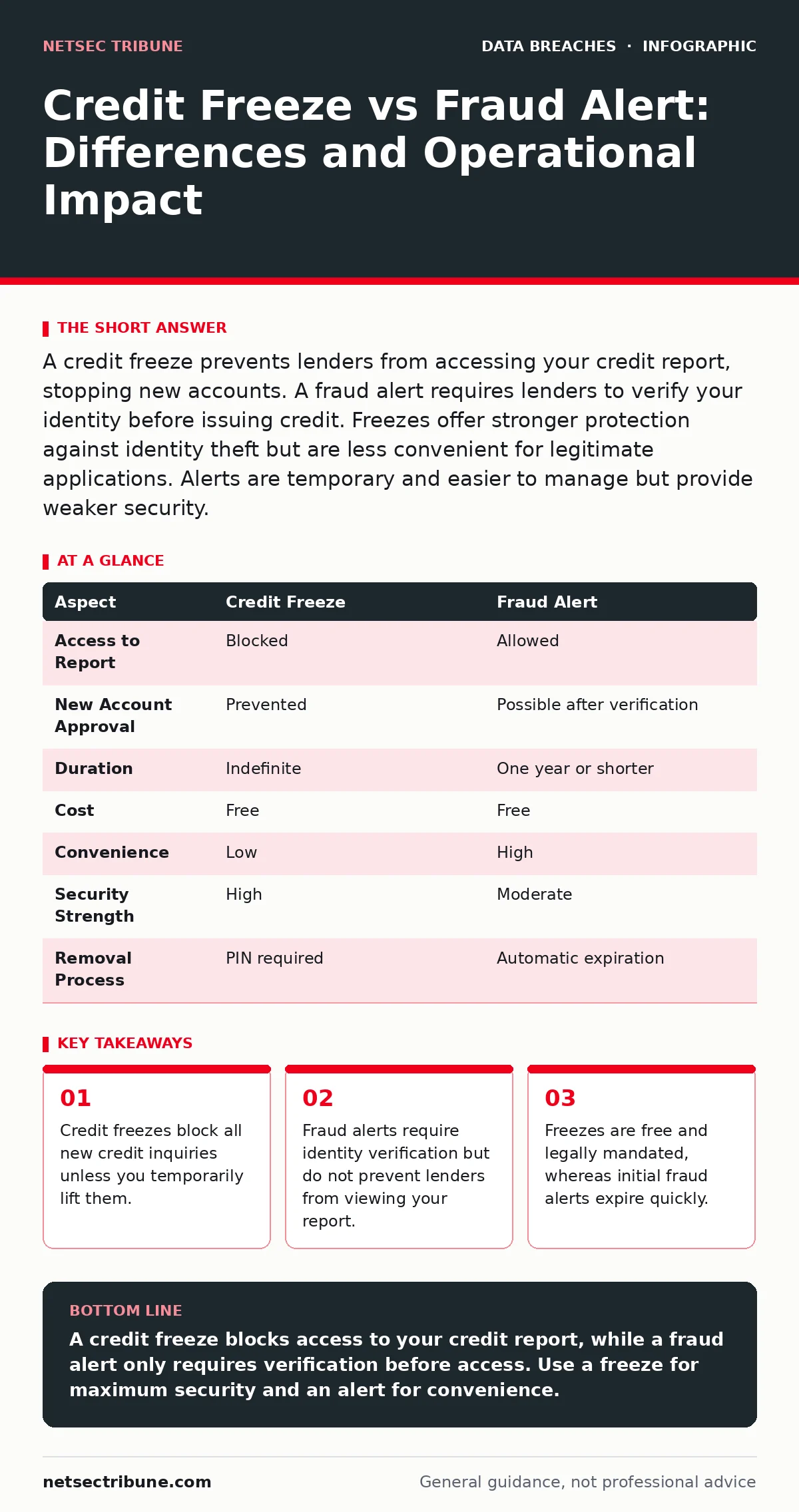
A credit freeze prevents lenders from accessing your credit report, stopping new accounts. A fraud alert requires lenders to verify your identity before issuing credit. Freezes offer stronger protection against identity theft but are less convenient for legitimate applications. Alerts are temporary and easier to manage but provide weaker security.
The Core Mechanical Difference
The fundamental distinction lies in access control. A credit freeze, also known as a security freeze, blocks access to your credit report entirely. Lenders cannot view your history, so they cannot approve new credit. A fraud alert does not block access. It places a flag on your file that triggers a mandatory identity verification step before any new credit is issued. One stops the process; the other slows it down with a checkpoint.
How a Credit Freeze Works
When you place a freeze, the credit reporting agencies lock your file. No lender can pull your report without your explicit permission. You must provide a PIN or password to lift the freeze temporarily or remove it entirely. This mechanism ensures that even if an attacker has your social security number and date of birth, they cannot open a new credit card or loan in your name. The freeze remains in place until you act. It does not expire.
How a Fraud Alert Works
A fraud alert is a less restrictive measure. It lasts for one year, unless you specify a shorter period. When a lender requests your report, the alert notifies them to verify your identity. This usually involves a phone call to a number you provided. The lender can still see your credit history. The alert serves as a warning sign, prompting extra caution. It does not stop the credit check itself. It only adds a layer of human verification.
Point-by-Point Comparison
| Aspect | Credit Freeze | Fraud Alert |
|---|---|---|
| Access to Report | Blocked | Allowed |
| New Account Approval | Prevented | Possible after verification |
| Duration | Indefinite | One year or shorter |
| Cost | Free | Free |
| Convenience | Low | High |
| Security Strength | High | Moderate |
| Removal Process | PIN required | Automatic expiration |
Operational Trade-offs
Freezes require more administrative effort. You must contact all three major credit bureaus to place or lift them. Each bureau has its own system. If you apply for multiple credit products, you must lift the freeze for each one. This creates a window of vulnerability. During that window, your file is exposed. Fraud alerts are simpler to manage. They apply across all bureaus with a single request. However, they are easier for determined attackers to bypass. If an attacker has enough personal data, they can pass the verification call.
See also: Data Breach Response: Containment, Recovery and Prevention Steps · Audit Logging Misconceptions: 6 Ways Teams Fail at Evidence
Where They Overlap
Both measures protect against unauthorized access to your credit profile. They are both free to the consumer. Federal law mandates that credit bureaus provide these services at no charge. Neither measure affects your credit score. Freezing your credit does not lower your rating. Adding a fraud alert does not change it. Both are reactive tools. They do not prevent the initial theft of your personal information. They only mitigate the impact after the data is lost.
Choosing the Right Tool
Choose a credit freeze when you want maximum protection. This is ideal for individuals who do not plan to apply for new credit soon. It is also suitable for those who have already experienced identity theft. The freeze stops the damage before it starts. It forces the attacker to find another victim.
Choose a fraud alert when you need flexibility. This works well if you apply for credit frequently. It is also useful if you expect to travel or move soon. The alert provides a basic layer of security without the hassle of lifting freezes. It is a good balance between convenience and protection.
Integration with Broader Security
These tools address identity theft, not technical breaches. They do not protect against data exfiltration from your devices. They do not prevent unauthorized access to your email accounts. For comprehensive protection, combine these measures with other security practices. Consider using full disk encryption to protect data on lost devices. Implement role-based access control to limit who can view sensitive information. Use encryption at rest for stored data. These technical controls complement the administrative protections of freezes and alerts.
Final Considerations
Both tools have their place. A freeze is a hard lock. An alert is a soft warning. You can use both simultaneously. Place a freeze for maximum security and add an alert for extra visibility. This layered approach covers more ground. It ensures that even if one measure fails, the other may catch the attempt. Remember that these tools do not replace good hygiene. They are supplements to a broader security strategy.
Key takeaways
- Credit freezes block all new credit inquiries unless you temporarily lift them.
- Fraud alerts require identity verification but do not prevent lenders from viewing your report.
- Freezes are free and legally mandated, whereas initial fraud alerts expire quickly.
A credit freeze blocks access to your credit report, while a fraud alert only requires verification before access. Use a freeze for maximum security and an alert for convenience.
Frequently asked questions
Does a credit freeze affect my credit score?
No, placing or lifting a freeze does not impact your credit score. Lenders cannot pull your report, so no hard inquiries are recorded.
Can I still use existing credit cards with a freeze?
Yes, existing accounts are not affected. Lenders do not need to pull your report for existing cards unless you apply for a limit increase.
How long does it take to lift a freeze?
It varies by bureau. Some lift freezes instantly online. Others may take up to two business hours. Plan ahead if you need immediate credit.
Is a fraud alert enough for high-risk individuals?
No, fraud alerts are easily bypassed by attackers with detailed personal information. A credit freeze provides stronger protection for high-risk scenarios.
How this guide was produced: written by the NetSec Tribune editorial team with AI assistance, checked against the public references listed below, and reviewed when the facts change. See our editorial policy or report an error.