
Encryption at Rest: Definition, Mechanics, and Operational Limits
Encryption at rest protects data on storage media but offers zero protection if an attacker gains valid access credentials or if the decryption keys are compromised.
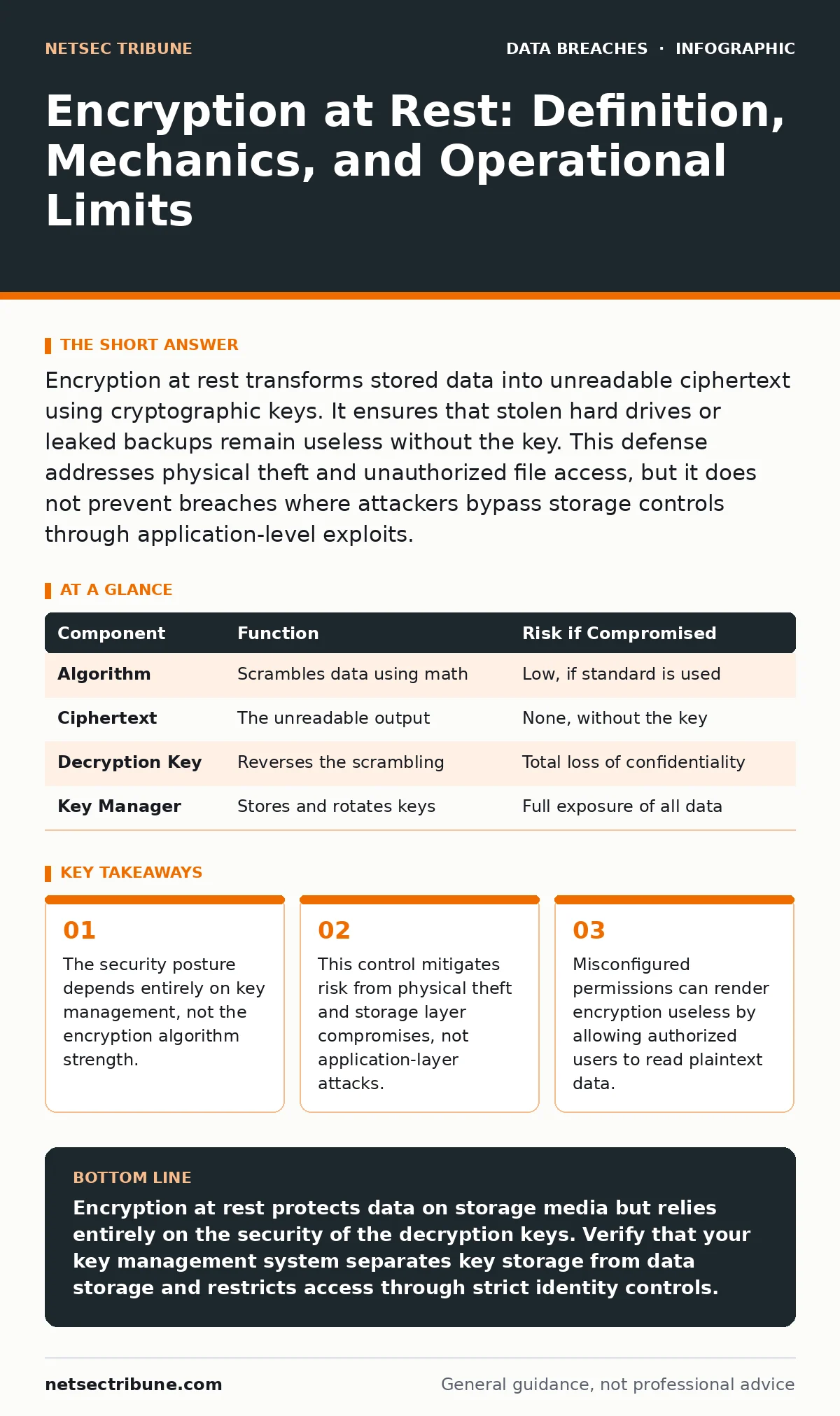
Encryption at rest transforms stored data into unreadable ciphertext using cryptographic keys. It ensures that stolen hard drives or leaked backups remain useless without the key. This defense addresses physical theft and unauthorized file access, but it does not prevent breaches where attackers bypass storage controls through application-level exploits.
The Static Shield Analogy
Imagine a heavy steel safe sitting in a lobby. If someone steals the safe, they possess the object but cannot open it without the combination. That is encryption at rest. Now imagine an employee with the combination walks in, opens the safe, and takes the contents. The safe did not fail; it performed exactly as designed. The breach occurred because the access control failed, not the encryption.
This analogy clarifies the primary function of this technology. It protects data when it is stationary on a device. It does not protect data while it moves across a network or while it is being processed in memory. Understanding this boundary prevents teams from expecting this control to stop attacks that occur at the application or network layer.
Core Definition and Purpose
Encryption at rest is the process of converting plaintext data into ciphertext before writing it to a storage medium. The transformation uses a cryptographic algorithm and a unique key. Without that specific key, the data remains unintelligible noise. This state persists until an authorized system or user provides the key to decrypt the data for use.
The purpose is to protect confidentiality when physical or logical storage controls fail. If a laptop is lost, a server is stolen, or a backup tape is misfiled, the data inside remains unreadable. It also provides a defense in depth against attackers who gain low-level access to the file system but lack the higher-level permissions required to retrieve the decryption keys.
The Three Critical Components
Three elements form the foundation of this control. First is the algorithm, which defines the mathematical method for scrambling data. Industry standards like AES provide proven security. Second is the data itself, which is the input to the algorithm. Third is the key, which is the secret value that allows the algorithm to reverse the process.
The key is the most fragile component. A strong algorithm is useless if the key is weak or poorly protected. Key management systems handle the generation, storage, rotation, and destruction of these keys. If the key is stored on the same server as the encrypted data without additional protection, an attacker who compromises the server can likely retrieve both. Separating the key storage from the data storage is a fundamental requirement for effective security.
| Component | Function | Risk if Compromised |
|---|---|---|
| Algorithm | Scrambles data using math | Low, if standard is used |
| Ciphertext | The unreadable output | None, without the key |
| Decryption Key | Reverses the scrambling | Total loss of confidentiality |
| Key Manager | Stores and rotates keys | Full exposure of all data |
Integration with Other Defenses
Encryption at rest does not operate in isolation. It sits alongside other controls to form a layered defense. For example, role-based access control determines who can request the decryption of specific files. If a user lacks the role, the system denies the request before the key is ever applied. This separation ensures that having physical access to the drive does not grant logical access to the data.
Consider the relationship with full disk encryption. This specific implementation encrypts the entire storage volume, including the operating system and temporary files. It is ideal for portable devices but requires careful handling of the boot process. If the pre-boot authentication is weak, an attacker can bypass the encryption by resetting the password or removing the drive from the chassis.
This control also intersects with data exfiltration prevention. If an attacker steals data that is already encrypted, they still need the keys to make the data usable. However, if the attacker steals the keys alongside the data, the exfiltration is successful. Therefore, monitoring key access logs is as critical as monitoring data access logs.
Common Misconceptions and Failures
Teams often assume that enabling encryption solves the problem of unauthorized access. This is incorrect. Encryption protects data from someone who should not have it. It does not stop someone who has legitimate access from doing something harmful. If a user with admin rights can read the data, encryption provides no additional protection against that user.
Another frequent error is reusing keys across multiple systems. If one system is compromised, all systems using that key are compromised. Key rotation mitigates this but introduces operational complexity. Teams must balance the frequency of rotation against the risk of service interruption.
Some organizations encrypt data but fail to encrypt the logs that record who accessed the keys. An attacker may not read the data immediately but can study the logs to understand which keys are valuable. This reconnaissance helps them target the key management system specifically.
See also: Data Exfiltration Explained: How Data Leaves Your Network · Passkeys: 6 Common Misunderstandings That Leave Accounts Exposed
Operational Costs and Trade-offs
Implementing this control adds latency. Every read and write operation requires encryption or decryption. This processing overhead can impact performance, especially on high-throughput systems. Teams must choose algorithms and hardware that balance security with speed. Software-based encryption consumes CPU cycles, while hardware-based encryption uses dedicated chips.
Key management adds administrative burden. Teams must track where every key is used, who has access to it, and when it was last rotated. Losing a key means losing the data permanently. There is no backdoor. This permanence is a feature, not a bug, but it requires rigorous backup and recovery procedures for the keys themselves.
What Gets Overlooked
Temporary files and swap space are often neglected. When an application processes data, it may write temporary copies to disk. If the main database is encrypted but the temporary files are not, an attacker who accesses the disk can recover fragments of the data. Full disk encryption mitigates this, but file-level encryption requires explicit configuration to cover these transient files.
Credential dumps also pose a risk. If an attacker steals credentials that grant access to the key management system, they can decrypt the data remotely. The physical security of the storage media becomes irrelevant. This highlights the need for strong authentication around the key management interface, independent of the data storage system.
Key takeaways
- The security posture depends entirely on key management, not the encryption algorithm strength.
- This control mitigates risk from physical theft and storage layer compromises, not application-layer attacks.
- Misconfigured permissions can render encryption useless by allowing authorized users to read plaintext data.
Encryption at rest protects data on storage media but relies entirely on the security of the decryption keys. Verify that your key management system separates key storage from data storage and restricts access through strict identity controls.
Frequently asked questions
Does encryption at rest protect data in transit?
No. Encryption at rest only protects data stored on disks or tapes. Data moving across a network requires separate encryption in transit protocols.
Can encryption at rest stop ransomware?
It cannot stop ransomware from encrypting files again. If the ransomware has access to the decryption keys, it can re-encrypt the data or steal it. It only helps if you have offline backups of the keys and data.
Is full disk encryption enough for a server?
Full disk encryption protects against physical theft of the drive. It does not protect against an attacker who logs into the server and accesses the data through the operating system.
How often should encryption keys be rotated?
Key rotation frequency depends on risk tolerance and operational capacity. Regular rotation limits the exposure window if a key is compromised, but it must be managed carefully to avoid data loss.
How this guide was produced: written by the NetSec Tribune editorial team with AI assistance, checked against the public references listed below, and reviewed when the facts change. See our editorial policy or report an error.