
Breach Notification Laws: Small Business Compliance Mechanics
Most small firms fail because they ignore data classification, turning minor credential leaks into reportable regulatory events.
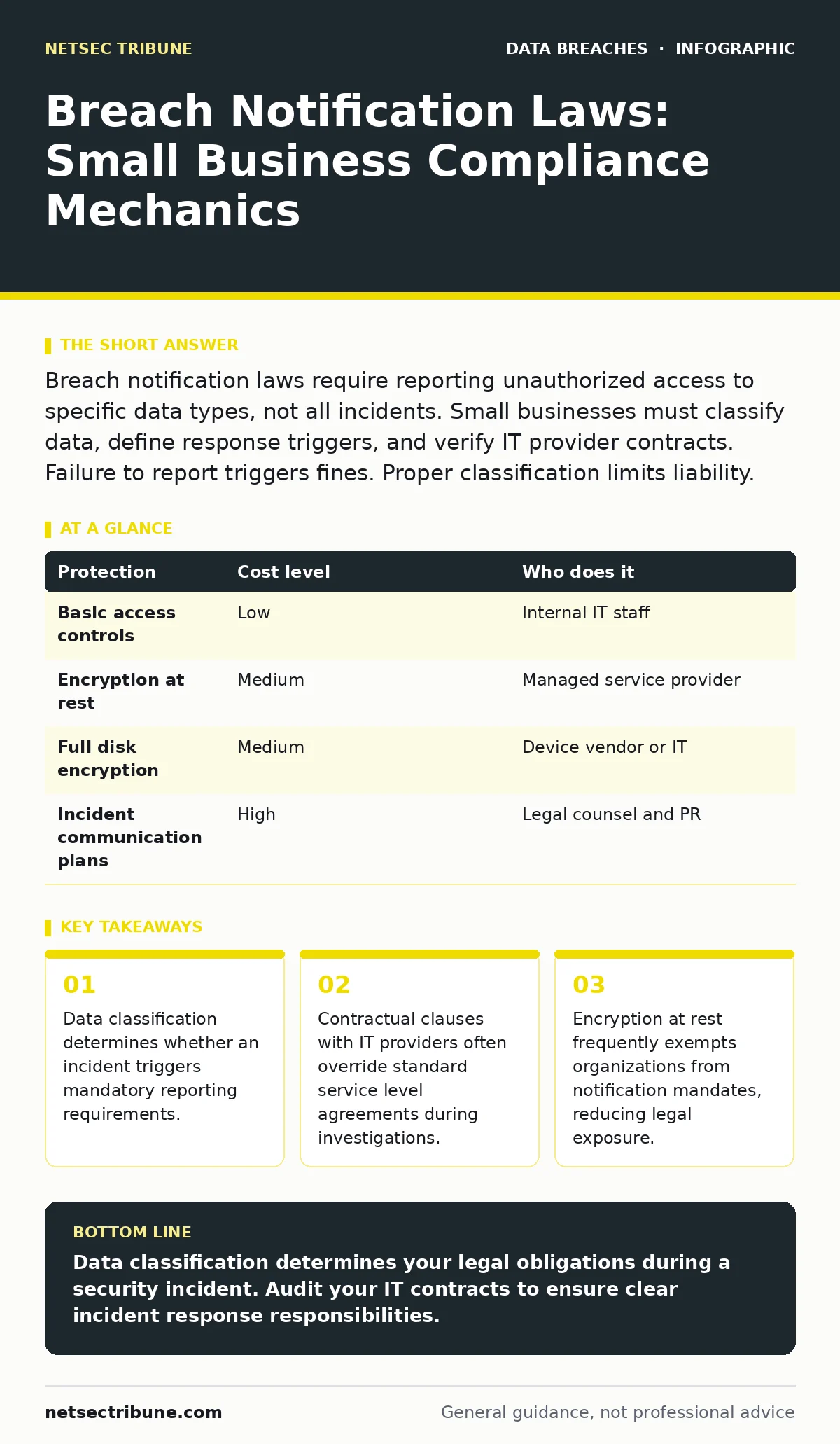
Breach notification laws require reporting unauthorized access to specific data types, not all incidents. Small businesses must classify data, define response triggers, and verify IT provider contracts. Failure to report triggers fines. Proper classification limits liability.
Defining Reportable Data Types
Breach notification laws do not treat all data equally. You must distinguish between general business information and protected data. Protected data usually includes names combined with financial identifiers, health records, or government IDs. If a hacker steals only internal memos, no report is due. If they steal customer names and credit card numbers, the clock starts.
The definition varies by jurisdiction. Some regions require notification for any unauthorized access to systems holding protected data. Others require proof of actual harm or misuse. You must map your data inventory to these definitions. This mapping prevents over-reporting, which wastes resources, and under-reporting, which invites penalties.
The Role of Data Classification
Data classification is the first line of defense against regulatory penalties. You categorize data based on sensitivity and legal requirements. Public data requires minimal protection. Internal data needs standard access controls. Confidential data demands strict access logs and encryption.
Without classification, you cannot determine if a breach occurred. Suppose a server is compromised. If it hosts only public marketing materials, you have no notification obligation. If it hosts customer addresses, you must act. Classification creates the boundary between a technical incident and a legal event. It allows you to respond proportionally to the risk.
| Protection | Cost level | Who does it |
|---|---|---|
| Basic access controls | Low | Internal IT staff |
| Encryption at rest | Medium | Managed service provider |
| Full disk encryption | Medium | Device vendor or IT |
| Incident communication plans | High | Legal counsel and PR |
Encryption as a Legal Shield
Encryption at rest often exempts you from notification requirements. If data is encrypted and the encryption key remains secure, regulators typically consider the data unreadable. This is known as the safe harbor provision. It applies only if the encryption meets current standards. Weak encryption does not count.
You must verify that your storage systems use strong encryption. This applies to laptops, servers, and cloud storage. If a device is lost, the absence of readable data means no breach occurred in the eyes of the law. This reduces the immediate cost of response. However, you still need to investigate the root cause to prevent future incidents.
Practical Steps for Small Teams
Small teams lack dedicated legal departments. You must build a simple workflow to handle potential breaches. Step 1 is containment. Isolate the affected system to stop data exfiltration. Step 2 is assessment. Determine what data was accessed and whether it was protected. Step 3 is documentation. Record every action taken, including timestamps and personnel involved.
Documentation protects you during audits. Regulators look for evidence of a good faith effort to secure data. A detailed log shows you followed a logical process. It demonstrates that you did not ignore the incident. Keep these logs secure. They may be subpoenaed in future litigation.
What to Ask Your IT Provider
Your IT provider plays a critical role in breach response. You must clarify responsibilities before an incident occurs. Do not assume they will notify you or handle legal requirements. Their primary duty is technical remediation. You must ask specific questions about their capabilities.
- Does your contract include incident response support?
- Who owns the forensic investigation costs?
- Will you preserve logs for legal discovery?
- Do you provide encryption key management?
- How quickly do you notify us of unauthorized access?
These questions reveal gaps in your coverage. Some providers charge extra for forensic work. Others may delete logs as part of their standard cleanup. You need explicit agreements on data retention and notification timelines. This prevents surprises when you need evidence most.
See also: Data Breach Response: Containment, Recovery and Prevention Steps · Audit Logging Misconceptions: 6 Ways Teams Fail at Evidence
Hidden Costs of Non-Compliance
Fines are the most obvious cost of non-compliance. However, the hidden costs are often higher. Reputational damage affects customer trust. Customers may leave if they perceive lax security. Legal fees for defense can exceed the initial fine. You also face the operational cost of manual reporting.
Imagine a scenario where you miss a reporting deadline. The penalty might be modest per record, but the aggregate sum grows quickly. More importantly, regulators may impose ongoing monitoring. This requires hiring external auditors. The long-term burden outweighs the cost of proper classification and encryption.
Integrating Related Security Measures
Breach notification is not an isolated task. It connects to broader security practices. You should review your incident communication plans to ensure clear messaging. Weak identity theft protection for customers can lead to secondary liability. Understanding credential dumps helps you assess the severity of a login breach.
Printed document leaks often escape digital monitoring but still trigger notification laws. You must include physical security in your classification strategy. Unauthorized access to physical servers is as reportable as remote hacking. Full disk encryption on mobile devices reduces the risk of physical theft. These measures work together to minimize reportable events.
Managing the Notification Process
When a reportable breach occurs, you must notify affected individuals. The notice must be clear and concise. Avoid legal jargon. Explain what happened, what data was involved, and what steps you took. Provide contact information for questions. Some jurisdictions require notification to credit bureaus or state attorneys general.
Timing is critical. Most laws set a strict deadline, often within 30 to 60 days of discovery. Start drafting the notice early. Legal review takes time. Delays can result in additional penalties. Use templates that comply with local regulations. Update them regularly to reflect changes in law.
Conclusion on Compliance Strategy
Compliance is not a one-time project. It is an ongoing operational requirement. You must update your data classification as business needs change. New services introduce new data types. Regular audits ensure your controls remain effective. Ignoring these updates creates blind spots.
Small businesses often underestimate the complexity of notification laws. The effort required to classify data and encrypt storage is significant. However, the cost of non-compliance is higher. By integrating these practices into your daily operations, you reduce risk. You also build trust with customers who value data privacy.
Key takeaways
- Data classification determines whether an incident triggers mandatory reporting requirements.
- Contractual clauses with IT providers often override standard service level agreements during investigations.
- Encryption at rest frequently exempts organizations from notification mandates, reducing legal exposure.
Data classification determines your legal obligations during a security incident. Audit your IT contracts to ensure clear incident response responsibilities.
Frequently asked questions
Do I need to notify customers if no data was stolen?
It depends on the jurisdiction. Some laws require notification if unauthorized access occurred, even if no data was exfiltrated. Check local regulations for specific triggers.
Can I use a template for breach notifications?
Yes, but customize it for each incident. Generic templates may miss specific legal requirements or fail to address the unique nature of the breach. Legal review is recommended.
How long do I need to keep breach logs?
Retention periods vary by law and industry. Keep logs for at least the statute of limitations period, often three to seven years. Consult legal counsel for specific requirements.
Does cloud storage encryption count for safe harbor?
Only if you control the encryption keys. If the provider manages keys, you may not meet the safe harbor criteria. Verify who holds the keys in your contract.
How this guide was produced: written by the NetSec Tribune editorial team with AI assistance, checked against the public references listed below, and reviewed when the facts change. See our editorial policy or report an error.