Incident Communication Plans: Benefits, Limits, and When to Skip
A pre-written communication plan reduces response time but cannot prevent technical failure or stop data from leaving your network.
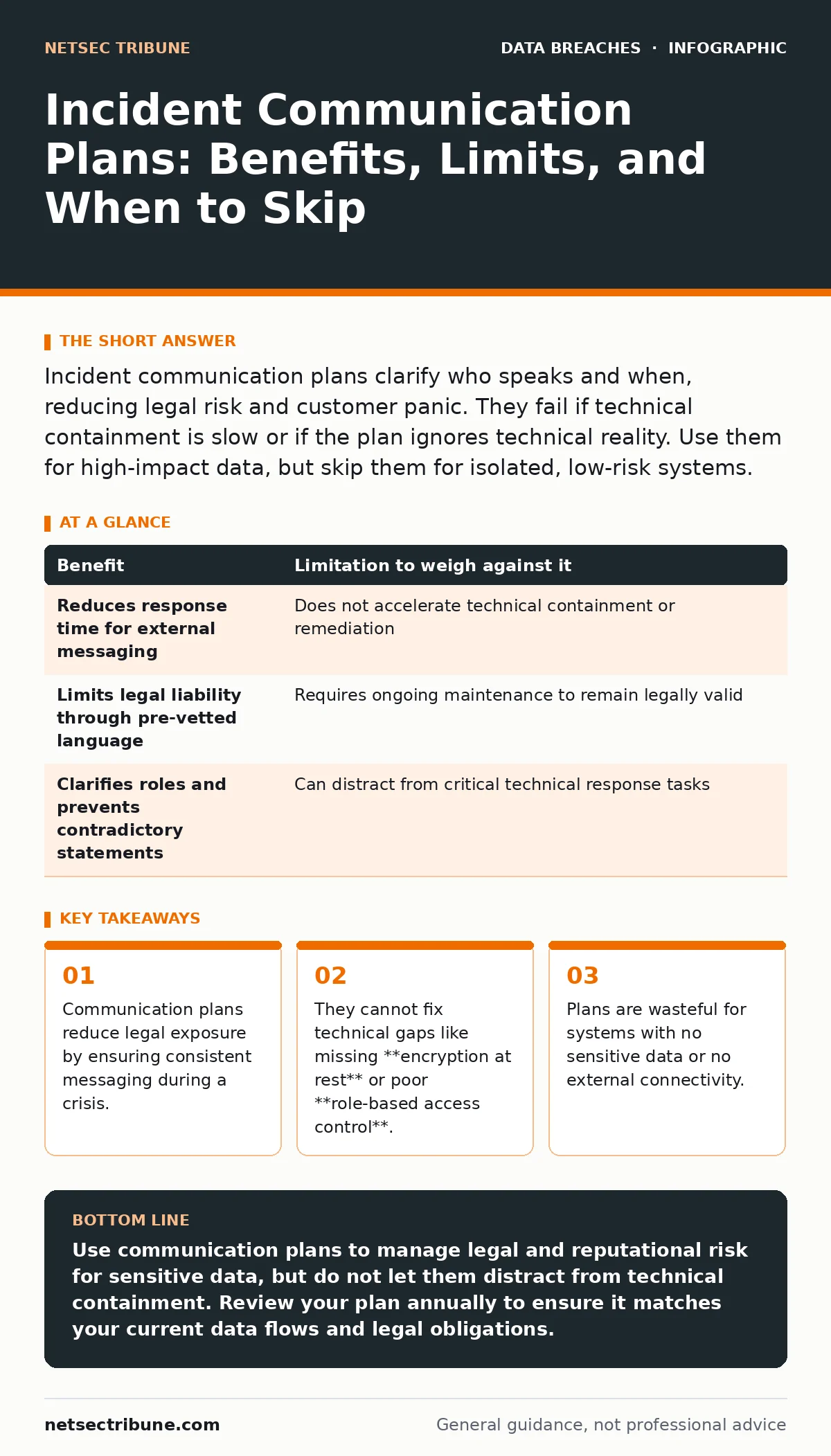
Incident communication plans clarify who speaks and when, reducing legal risk and customer panic. They fail if technical containment is slow or if the plan ignores technical reality. Use them for high-impact data, but skip them for isolated, low-risk systems.
The Function of Pre-Written Messaging
An incident communication plan is a set of pre-approved messages and decision trees. It dictates who speaks to the media, regulators, and customers after a security event. The goal is not to hide the truth, but to present it clearly and legally. Without this structure, teams often contradict each other under pressure.
This document works alongside technical response procedures. It does not replace the need to isolate infected systems or analyze credential dumps. It ensures that while engineers work on containment, the organization’s external image remains stable. Consistency in messaging prevents rumors from filling the silence.
Concrete Benefits of Structured Communication
The primary benefit is speed. When a breach occurs, every minute of silence increases uncertainty. A pre-written plan allows you to issue a holding statement immediately. This buys time for technical teams to assess the scope of data exfiltration.
Legal teams also benefit from standardized language. These documents are usually reviewed by counsel before an incident occurs. This reduces the risk of admitting liability prematurely. You avoid making promises you cannot keep, such as guaranteeing no harm will come to affected users.
Another benefit is clarity of roles. The plan defines who has the authority to speak. This prevents junior staff from giving interviews that contradict senior leadership. It also ensures that technical details are verified before release. Misinformation can cause more damage than the breach itself.
Honest Limitations of the Plan
A communication plan does not stop the attack. It is a reactive measure, not a preventive one. If you lack full disk encryption, attackers can still read stolen drives. The plan only manages the fallout, not the cause.
Plans can become outdated quickly. Technology changes, and so do regulatory requirements. A message that was legally sound years ago may now violate new privacy laws. Maintaining these documents requires constant effort. Many teams neglect this, leading to stale advice.
There is also a risk of over-reliance. Teams may focus so much on messaging that they neglect technical containment. If the server is still compromised, a perfect press release is meaningless. The plan cannot compensate for poor security hygiene.
| Benefit | Limitation to weigh against it |
|---|---|
| Reduces response time for external messaging | Does not accelerate technical containment or remediation |
| Limits legal liability through pre-vetted language | Requires ongoing maintenance to remain legally valid |
| Clarifies roles and prevents contradictory statements | Can distract from critical technical response tasks |
When It Is Worth It
You need a communication plan if you handle sensitive personal data. This includes health records, financial information, or private communications. A breach here triggers legal notifications and potential fines. The cost of a plan is low compared to the cost of non-compliance.
It is also worth it for services with high public visibility. If your users are consumers, panic spreads quickly. A clear message helps retain trust. For businesses relying on email encryption or other trust signals, a breach damages brand reputation. The plan helps mitigate this damage.
Imagine a cloud provider that hosts customer databases. If a vulnerability is found, thousands of customers need to know. A generic email is insufficient. A detailed plan ensures each customer receives specific, relevant information. This scales the response effectively.
When It Is Not Worth It
If your system has no sensitive data, a formal plan is likely unnecessary. Suppose you run an internal tool for tracking office supplies. A breach here might be annoying, but it carries no legal risk. Spending weeks drafting messages is a waste of resources.
It is also not worth it for isolated systems. If a device has no network connection and no external users, the impact is limited. You can handle communication ad-hoc. Formalizing the process adds bureaucracy without adding value.
Consider a development environment with test data. If malicious PyPI packages infect this environment, the damage is contained. You do not need to notify customers or regulators. A simple internal note suffices. Do not over-engineer communication for low-risk assets.
See also: Difference Between Cloud Logging and Monitoring: Operational Reality · Decoding Ransom Notes: Evidence Handling and Negotiation Realities
The Hidden Cost of Maintenance
Creating a plan is easy. Keeping it current is hard. This is the hidden cost that many teams ignore. Regulations change, and so do your data flows. A plan written for one regulatory framework may not apply to another.
You must review the plan regularly. This requires time from legal, PR, and security teams. If you do not update it, the plan becomes a liability. Using outdated language can lead to legal errors. The cost of maintenance is often higher than the initial creation.
Integrating With Technical Response
The communication plan must align with technical capabilities. If your plan promises immediate notification, your detection systems must be fast. If you cannot detect unauthorized access in real-time, you cannot communicate in real-time.
Ensure your technical teams understand the communication triggers. They need to know when to alert the PR team. This integration prevents gaps in response. A seamless handoff between technical and communication teams is critical.
The plan should also account for technical limitations. If you cannot determine the scope of a breach quickly, the plan should include language for uncertainty. Do not promise precision if your tools do not support it. Honesty builds more trust than false certainty.
Final Considerations
A communication plan is a tool, not a solution. It helps manage the human and legal aspects of a breach. It does not fix technical vulnerabilities. Use it where the risk is high and the impact is significant.
Skip it for low-risk, isolated systems. Focus your resources on prevention and detection. A strong security posture reduces the need for crisis communication. The best breach is the one that never happens.
Key takeaways
- Communication plans reduce legal exposure by ensuring consistent messaging during a crisis.
- They cannot fix technical gaps like missing **encryption at rest** or poor **role-based access control**.
- Plans are wasteful for systems with no sensitive data or no external connectivity.
Use communication plans to manage legal and reputational risk for sensitive data, but do not let them distract from technical containment. Review your plan annually to ensure it matches your current data flows and legal obligations.
Frequently asked questions
How often should I update my incident communication plan?
Review it at least annually or whenever your data processing activities change. Regulatory shifts also require immediate updates to ensure compliance.
Who should be involved in creating the plan?
Include legal, public relations, security engineering, and executive leadership. Each group provides a necessary perspective on risk and messaging.
Can a communication plan help with ransomware attacks?
Yes, by providing clear guidance on whether to pay or negotiate. It also helps manage stakeholder expectations during the disruption.
Is a plan needed for minor security incidents?
Only if they involve sensitive data or affect public trust. For internal, low-impact issues, informal communication is usually sufficient.
How this guide was produced: written by the NetSec Tribune editorial team with AI assistance, checked against the public references listed below, and reviewed when the facts change. See our editorial policy or report an error.