What is Exposure Management in Cybersecurity: The Continuous Reality Check
Exposure management reveals hidden attack paths by correlating asset identity with real-time context, exposing risks that traditional scans miss.
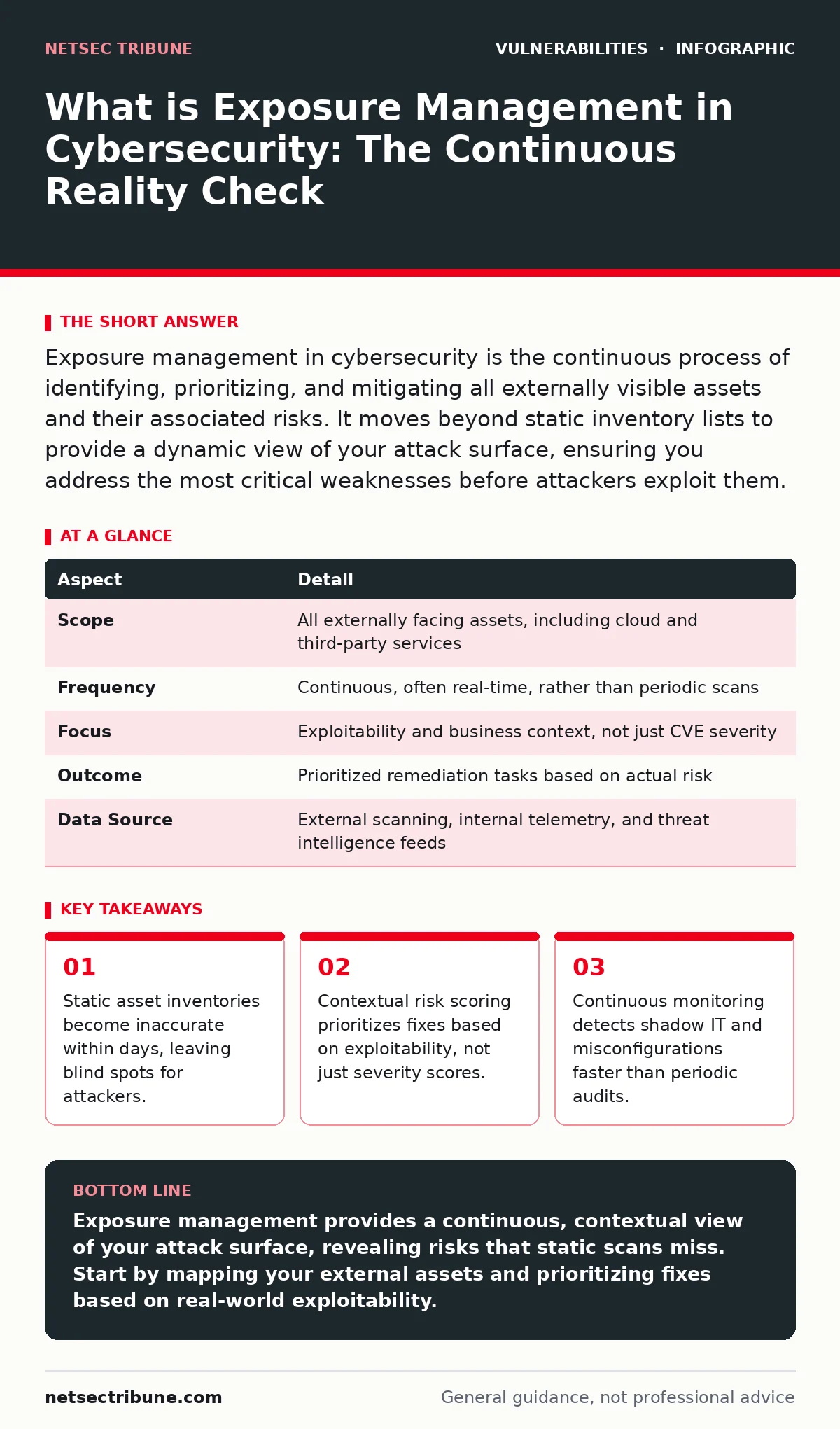
Exposure management in cybersecurity is the continuous process of identifying, prioritizing, and mitigating all externally visible assets and their associated risks. It moves beyond static inventory lists to provide a dynamic view of your attack surface, ensuring you address the most critical weaknesses before attackers exploit them.
Everyday Analogy: The House Perimeter
Imagine securing a large estate. A traditional security guard checks the main gate every night. He ensures the lock is engaged and the light is on. He records this in a logbook. This is how most organizations handle security. They check the known entry points. They verify the locks work. They assume that because the gate is secure, the property is safe.
Exposure management is different. It is like deploying drones that fly the perimeter every hour. These drones see the side gate left ajar by a delivery driver. They spot the basement window broken by falling branches. They notice the contractor’s ladder leaning against the second-story balcony. The guard at the main gate never sees these issues. The inventory of "doors" did not include the basement window or the ladder. The risk exists outside the known map.
What is Exposure Management in Cybersecurity
Exposure management in cybersecurity is the discipline of continuously discovering and assessing all assets that an attacker can reach. It combines asset discovery, vulnerability detection, and threat intelligence into a single workflow. The goal is to understand the true attack surface, not just the planned one. This approach answers what a person typing "what is exposure management in cybersecurity" wants to know: how to see everything before the adversary does.
Traditional security tools often operate in silos. One tool scans for vulnerabilities. Another manages firewalls. A third tracks software licenses. None of these tools share context. A vulnerability scanner might flag a low-severity issue on a test server. Without context, the team ignores it. Exposure management connects the dots. It reveals that the test server is publicly accessible and lacks authentication. The risk is high, not low.
| Aspect | Detail |
|---|---|
| Scope | All externally facing assets, including cloud and third-party services |
| Frequency | Continuous, often real-time, rather than periodic scans |
| Focus | Exploitability and business context, not just CVE severity |
| Outcome | Prioritized remediation tasks based on actual risk |
| Data Source | External scanning, internal telemetry, and threat intelligence feeds |
How Exposure Management Works
The process begins with discovery. Automated agents scan the internet for any service connected to your domain or IP range. This includes forgotten development environments, decommissioned servers still running, and personal devices connected via remote access tools. The system builds a complete map of the attack surface. It identifies every open port, every running service, and every certificate.
Next, the system assesses risk. It does not just list vulnerabilities. It evaluates how easy it is to exploit them. A vulnerability with a high severity score might be difficult to reach. A lower severity issue might be exposed on a public-facing login page. Exposure management uses context to rank these issues. It considers whether the asset holds sensitive data, whether it is connected to critical internal systems, and whether active exploits exist in the wild.
Finally, the system guides remediation. It provides clear instructions for fixing the highest-risk issues first. It tracks the status of each fix. If a patch fails or a configuration drift occurs, the system alerts the team immediately. This creates a feedback loop. The more you fix, the more accurate your view of the remaining risk becomes.
Who It Affects
This approach affects every organization with a digital presence. Small businesses with a single website benefit from knowing if their server is misconfigured. Large enterprises with complex cloud infrastructures need it to manage thousands of assets. The complexity of modern networks makes manual tracking impossible.
Security teams are the primary users. They shift from reacting to alerts to proactively reducing risk. They spend less time investigating false positives and more time fixing real issues. Developers also benefit. They receive immediate feedback on the security of their code before it reaches production. This reduces the cost of fixing bugs later in the lifecycle.
Imagine a company that uses a web application firewall to block common attacks. The firewall works well. It stops known attack patterns. However, it does not prevent misconfigurations. If a developer accidentally exposes an administrative interface, the firewall may not block it. Exposure management would detect this exposure immediately. It would alert the team before an attacker finds it.
What People Usually Get Wrong
Many organizations confuse exposure management with vulnerability management programs. Vulnerability management focuses on known flaws in software. It relies on periodic scans and patching cycles. Exposure management is broader. It includes misconfigurations, missing controls, and architectural weaknesses. A system can have no known vulnerabilities but still be highly exposed due to poor network segmentation.
Another common error is treating exposure as a one-time project. Attackers do not stop scanning. They probe continuously. If you stop monitoring, new exposures appear. Shadow IT grows. Employees create new cloud instances without notifying security. These assets become invisible to traditional tools. Continuous monitoring is the only way to keep pace.
See also: Difference Between Cloud Logging and Monitoring: Operational Reality
Integration With Other Controls
Exposure management complements other security measures. It works alongside input validation to ensure data entering the system is safe. It supports cross-site request forgery (CSRF) protections by identifying exposed endpoints that lack proper anti-CSRF tokens. It highlights security misconfigurations that might bypass web application firewalls.
It also reveals race condition vulnerabilities that static analysis might miss. By observing the system in real-time, it can detect timing issues that allow attackers to manipulate concurrent processes. It helps identify mass assignment vulnerabilities where users can modify fields they should not touch. It does not replace these controls. It ensures they are present and effective across all assets.
What To Do About It
Start by mapping your external attack surface. Use automated tools to discover all public-facing assets. Compare this list with your internal inventory. Identify the gaps. These gaps are your blind spots. Prioritize them for immediate review.
Implement continuous monitoring. Set up alerts for new assets, changes in configuration, and detected vulnerabilities. Integrate these alerts into your existing workflow. Ensure the right teams are notified. Do not let alerts sit in a dashboard. Action is required.
Focus on context. Not all vulnerabilities are equal. Prioritize fixes based on exploitability and business impact. Address the most critical exposures first. Track your progress. Measure the reduction in risk over time. This data helps justify further investment in security controls.
Key takeaways
- Static asset inventories become inaccurate within days, leaving blind spots for attackers.
- Contextual risk scoring prioritizes fixes based on exploitability, not just severity scores.
- Continuous monitoring detects shadow IT and misconfigurations faster than periodic audits.
Exposure management provides a continuous, contextual view of your attack surface, revealing risks that static scans miss. Start by mapping your external assets and prioritizing fixes based on real-world exploitability.
Frequently asked questions
How does exposure management differ from asset management?
Asset management tracks what you own. Exposure management tracks what attackers can reach, including assets you may have forgotten or do not own but rely on.
Do I need exposure management if I have a firewall?
Yes. Firewalls block traffic based on rules. They do not identify new assets or misconfigurations. Exposure management finds the holes in your defenses before attackers do.
Can exposure management prevent zero-day attacks?
It cannot prevent unknown vulnerabilities. It can, however, reduce the likelihood of success by minimizing the attack surface and ensuring strict access controls are in place.
How often should I run exposure management scans?
Continuously. Attackers scan your environment constantly. Your monitoring should match their frequency to detect new exposures in real-time.
How this guide was produced: written by the NetSec Tribune editorial team with AI assistance, checked against the public references listed below, and reviewed when the facts change. See our editorial policy or report an error.