
HTTP Request Smuggling: Mechanisms, Detection, and Mitigation
HTTP request smuggling exploits parsing differences between proxies and backend servers, allowing attackers to hijack other users' sessions or bypass security controls without exploiting code bugs.
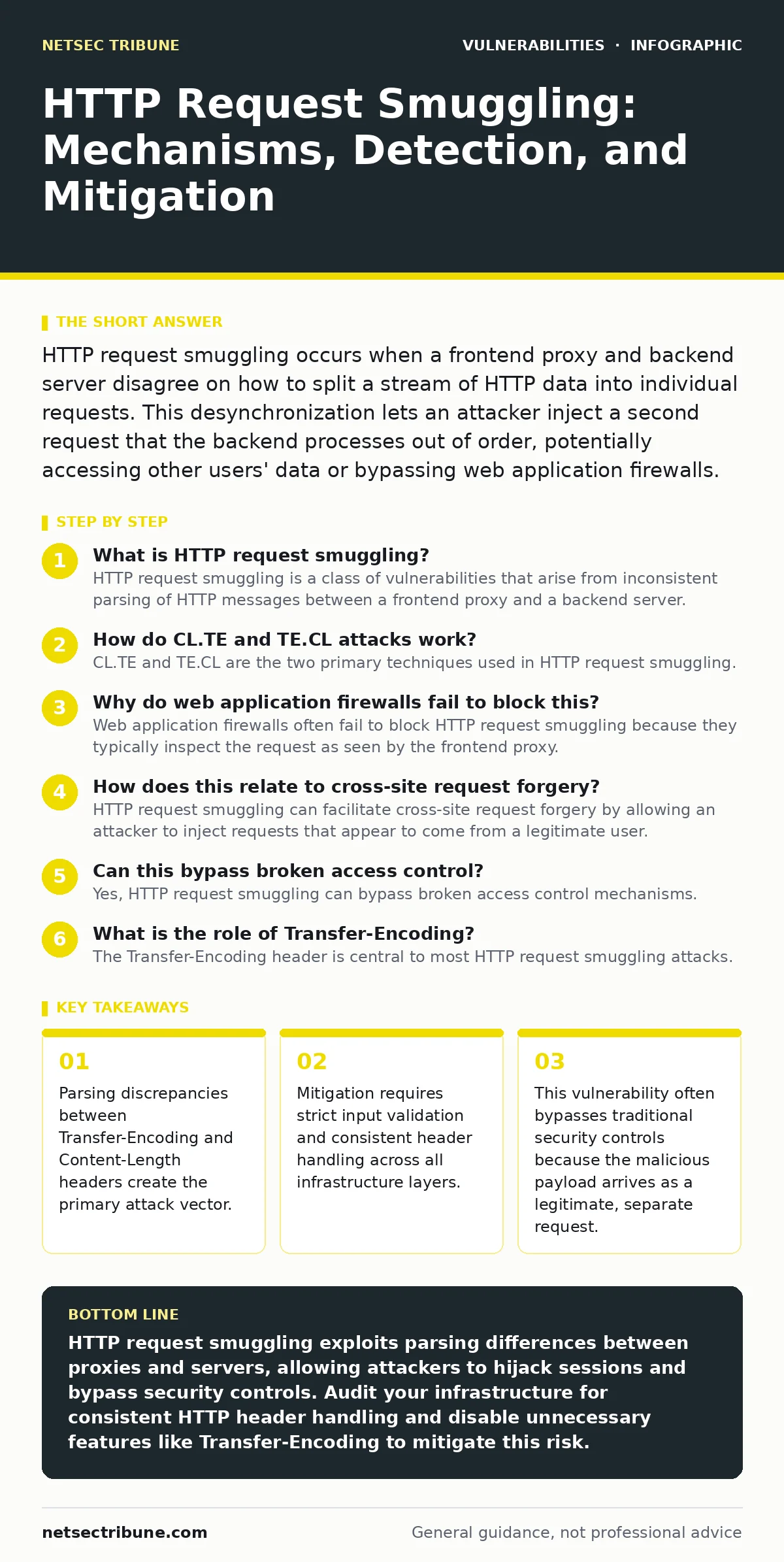
HTTP request smuggling occurs when a frontend proxy and backend server disagree on how to split a stream of HTTP data into individual requests. This desynchronization lets an attacker inject a second request that the backend processes out of order, potentially accessing other users' data or bypassing web application firewalls.
What is HTTP request smuggling?
HTTP request smuggling is a class of vulnerabilities that arise from inconsistent parsing of HTTP messages between a frontend proxy and a backend server. When these two components disagree on where one request ends and the next begins, an attacker can inject a second request that the backend processes later. This allows the attacker to manipulate the state of the connection for subsequent users.
The core issue is not a bug in the application code itself, but a mismatch in how different software interprets the HTTP specification. This makes it a form of security misconfigurations rather than a traditional software flaw.
How do CL.TE and TE.CL attacks work?
CL.TE and TE.CL are the two primary techniques used in HTTP request smuggling. In a CL.TE attack, the attacker sends a Content-Length header that the frontend proxy respects, but includes a Transfer-Encoding header that the backend server respects. The frontend splits the request based on the byte count, while the backend waits for the chunked encoding terminator.
In a TE.CL attack, the roles are reversed. The frontend proxy processes the Transfer-Encoding header, splitting the request early, while the backend server relies on the Content-Length header to determine the request boundary. This discrepancy allows the attacker to hide a second request within the body of the first.
| Attack Type | Frontend Parser Uses | Backend Parser Uses | Result |
|---|---|---|---|
| CL.TE | Content-Length | Transfer-Encoding | Backend desync |
| TE.CL | Transfer-Encoding | Content-Length | Backend desync |
Why do web application firewalls fail to block this?
Web application firewalls often fail to block HTTP request smuggling because they typically inspect the request as seen by the frontend proxy. If the proxy parses the request correctly, the WAF sees a valid, benign request. The malicious payload is hidden in the portion of the data that the backend server processes differently.
This blind spot means that even a well-configured security layer can be bypassed without triggering any alerts. The attack succeeds because the security device and the target server speak slightly different dialects of the HTTP protocol.
How does this relate to cross-site request forgery?
HTTP request smuggling can facilitate cross-site request forgery by allowing an attacker to inject requests that appear to come from a legitimate user. By hijacking the connection, the attacker can force the backend server to process actions on behalf of another user who connects to the same proxy shortly after.
This is more powerful than standard CSRF because it does not rely on the victim clicking a link. Instead, it relies on the timing of connections and the persistent desynchronization of the HTTP pipeline.
Can this bypass broken access control?
Yes, HTTP request smuggling can bypass broken access control mechanisms. If an attacker can inject a request that the backend processes out of order, they might access resources intended for a different user or session. The backend server may associate the injected request with the next legitimate user's session.
This effectively allows privilege escalation or data leakage without needing to exploit a specific authorization bug in the application logic. The vulnerability lies in the transport layer, not the application's permission checks.
See also: Website Defacement Attack: How It Works and How to Stop It · What Is Input Validation: How to Stop Bad Data From Breaking Systems
What is the role of Transfer-Encoding?
The Transfer-Encoding header is central to most HTTP request smuggling attacks. It indicates that the message body is encoded in a specific way, usually chunked encoding. Different servers handle the interaction between Transfer-Encoding and Content-Length differently, often violating the HTTP specification.
However, many proxies and servers ignore this rule, leading to the parsing discrepancies that attackers exploit.
How do you detect HTTP request smuggling?
Detection often involves sending crafted requests and observing the server's response. Look for delayed responses, unexpected errors, or data from other users' requests appearing in your response. Automated scanners can test for common smuggling patterns by sending requests with conflicting headers.
Manual testing is still required because automated tools may not cover all edge cases or specific server configurations. You must verify that the backend server handles headers consistently with the frontend proxy.
What is the fix for HTTP request smuggling?
The most effective fix is to ensure that all infrastructure components parse HTTP requests consistently. This often means configuring frontend proxies to reject requests with conflicting Transfer-Encoding and Content-Length headers. You should also disable unnecessary HTTP features like chunked encoding in proxies.
Regularly updating your servers and proxies is also critical, as vendors frequently patch parsing inconsistencies. Additionally, implementing strict input validation at the application level can help mitigate the impact of any residual parsing issues.
Are zero-day vulnerabilities involved?
HTTP request smuggling is generally not a zero-day vulnerability in the traditional sense. It is a known class of vulnerability that arises from configuration and implementation differences. However, specific instances of smuggling may be unknown to the server administrators until an attacker discovers them.
This means that while the technique is well-documented, your specific infrastructure may still be vulnerable if it has not been tested. Regular security assessments are necessary to identify these parsing discrepancies before attackers do.
How does this compare to path traversal?
Unlike path traversal vulnerabilities, which exploit how an application interprets file paths, HTTP request smuggling exploits how infrastructure interprets network protocols. Path traversal allows an attacker to read files outside the web root, while smuggling allows them to manipulate the HTTP pipeline.
Both can lead to data exposure, but the mechanisms and mitigations are entirely different. Fixing path traversal requires input validation, while fixing smuggling requires consistent HTTP parsing.
Key takeaways
- Parsing discrepancies between Transfer-Encoding and Content-Length headers create the primary attack vector.
- Mitigation requires strict input validation and consistent header handling across all infrastructure layers.
- This vulnerability often bypasses traditional security controls because the malicious payload arrives as a legitimate, separate request.
HTTP request smuggling exploits parsing differences between proxies and servers, allowing attackers to hijack sessions and bypass security controls. Audit your infrastructure for consistent HTTP header handling and disable unnecessary features like Transfer-Encoding to mitigate this risk.
Frequently asked questions
Can HTTP request smuggling be used to inject SQL commands?
No, HTTP request smuggling is a transport-layer issue. It does not directly inject SQL commands, but it can bypass WAFs that would otherwise block such attempts.
Is HTTP/2 vulnerable to request smuggling?
HTTP/2 uses binary framing and multiplexing, which makes traditional HTTP request smuggling techniques ineffective. However, HTTP/2 has its own set of vulnerabilities, such as Rapid Reset attacks.
Do all web servers have this vulnerability?
No, but many do. The vulnerability exists wherever there is a mismatch in HTTP parsing between a frontend proxy and a backend server. Proper configuration can prevent it.
How do I test my application for this?
Use specialized security scanners that test for HTTP desynchronization. Manual testing with crafted requests containing conflicting headers is also recommended for thorough coverage.
How this guide was produced: written by the NetSec Tribune editorial team with AI assistance, checked against the public references listed below, and reviewed when the facts change. See our editorial policy or report an error.