
Data Masking Examples: How to Hide Sensitive Information Safely
Data masking replaces real values with fictional substitutes that preserve format and functionality while removing the ability to reconstruct original sensitive records.
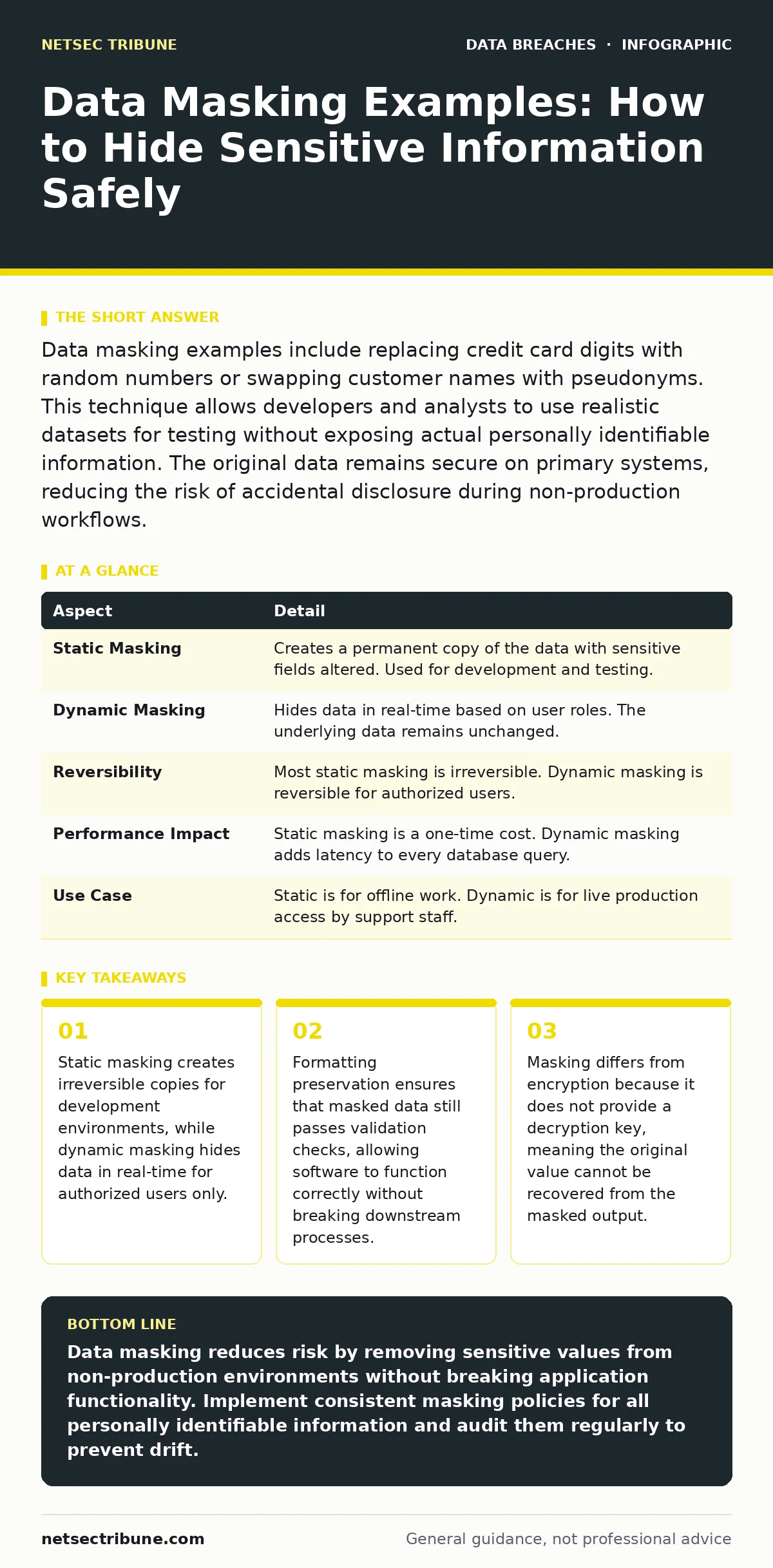
Data masking examples include replacing credit card digits with random numbers or swapping customer names with pseudonyms. This technique allows developers and analysts to use realistic datasets for testing without exposing actual personally identifiable information. The original data remains secure on primary systems, reducing the risk of accidental disclosure during non-production workflows.
Understanding Data Masking Mechanics
Data masking is the process of concealing specific data characters within a database with new, non-sensitive characters. It produces a realistic alternative structure of the sensitive company data. The goal is to maintain the integrity of the data for testing purposes while ensuring that no one can derive the original information.
Imagine a bakery that needs to test its order processing software. The developers need customer names and phone numbers to verify that the system handles input correctly. However, they do not need the actual contact details of real customers. They replace "John Smith" with "Alice Jones" and the real phone number with a valid but fake sequence. The software behaves as if it is processing real data, but the privacy of the original customers remains intact.
This approach differs significantly from encryption at rest. Encryption scrambles data using a key that allows authorized parties to reverse the process and read the original content. Masking, particularly static masking, is typically irreversible. Once the data is masked, the original value is lost from that specific dataset. This irreversibility is the core security benefit. It prevents attackers who steal a development database from recovering the source material.
Common Data Masking Examples
Practitioners often search for data masking examples to understand how different data types are handled. Here are 4 standard techniques used in production and development environments:
- Substitution: This method replaces sensitive data with realistic but fake values. For instance, a real customer name is swapped with another name from a predefined list of pseudonyms. The format remains identical, which helps maintain referential integrity across tables.
- Shuffling: This technique permutes values within a column. If a database contains 100 salaries, the values are rearranged so that no employee’s salary is linked to their correct record. The statistical distribution of the data remains accurate, which is useful for trend analysis.
- Nulling out: This approach replaces sensitive fields with null values or blanks. It is the simplest form of masking but offers the least utility for testing. Applications that require a value in every field may crash or behave unexpectedly when encountering nulls.
- Format-preserving encryption: This method encrypts data while keeping the same format and length. A 16-digit credit card number is transformed into another 16-digit number. This allows validation scripts to pass without modification, which is critical for rigorous software testing.
| Aspect | Detail |
|---|---|
| Static Masking | Creates a permanent copy of the data with sensitive fields altered. Used for development and testing. |
| Dynamic Masking | Hides data in real-time based on user roles. The underlying data remains unchanged. |
| Reversibility | Most static masking is irreversible. Dynamic masking is reversible for authorized users. |
| Performance Impact | Static masking is a one-time cost. Dynamic masking adds latency to every database query. |
| Use Case | Static is for offline work. Dynamic is for live production access by support staff. |
Static Versus Dynamic Implementation
The choice between static and dynamic masking depends on where the data lives and who needs to see it. Static masking involves creating a separate copy of the database. The sensitive elements are altered before the copy is distributed to developers or analysts. This copy can be moved to insecure environments, such as a developer’s local laptop, because it contains no real sensitive data.
Dynamic masking applies rules at the time of access. The data remains in its original form in the database. When a user queries the data, the database engine intercepts the request and masks the results before sending them back. This method is useful for role-based access control in production environments. It allows different users to see different levels of detail based on their permissions.
Static masking has a hidden cost: data drift. The masked copy becomes outdated as soon as it is created. If the production database changes, the static copy no longer reflects reality. This can lead to bugs that only appear in production. Dynamic masking avoids this issue because it always reflects the current state of the database. However, dynamic masking adds computational overhead to every query. This latency can degrade performance in high-throughput systems.
What People Usually Get Wrong
Many organizations confuse masking with obfuscation or simple truncation. Truncation reduces the length of a field, such as showing only the last 4 digits of a phone number. While this protects the full value, it can break applications that require a specific field length. Masking preserves the format, which prevents these integration failures.
Another common error is assuming that masking alone prevents data breaches. Masking protects data in use and in development. It does not protect data in transit or at rest if the underlying storage is compromised. Attackers who bypass the application layer and access the raw database files will see the unmasked data if only dynamic masking is in place. For comprehensive security, masking must be combined with other controls.
Organizations often fail to apply masking to derived data. If you mask a customer’s name but leave their email address unmasked, an attacker can re-identify the individual by cross-referencing public records. All personally identifiable information fields must be masked consistently. This includes seemingly harmless fields like postal codes or birth dates, which can be combined to identify individuals.
Integrating With Broader Security Controls
Masking is not a standalone solution. It works best when integrated with a broader security architecture. For instance, if an attacker gains access to a system, they may attempt data exfiltration. Masked data reduces the value of the stolen information, but it does not stop the theft itself. Network monitoring and intrusion detection systems remain necessary to detect unauthorized transfers.
Consider the risk of identity theft protection. If personal data is leaked, victims often seek services to monitor their credit and identity. Masking reduces the likelihood of such leaks occurring in the first place. By ensuring that only masked data reaches third-party vendors or development environments, you minimize the attack surface.
Email encryption is another related control. If you send reports containing sensitive data to external partners, masking the data before it leaves your network is safer than relying solely on email encryption. Encryption protects the data in transit, but masking ensures that even if the encryption is broken or the recipient’s device is compromised, the underlying data remains safe.
Full disk encryption protects data on lost or stolen devices. However, if a developer has a static copy of the database on their laptop, full disk encryption only helps if the device is lost. If the developer accidentally commits the database to a public repository, the encryption is irrelevant. Masking ensures that the data in the repository is harmless.
See also: Printed Document Leak Myths: What Security Teams Get Wrong · Data Breach Response: Containment, Recovery and Prevention Steps
Managing the Lifecycle of Masked Data
The lifecycle of masked data begins with policy definition. You must decide which fields require masking and which masking algorithm to use for each data type. This decision affects the usability of the data for testing. Over-masking can render data useless for testing complex business logic. Under-masking exposes sensitive information.
Regular audits are necessary to ensure that masking rules are applied correctly. Database schemas change over time. New columns may be added that contain sensitive data but are not covered by existing masking rules. Automated scanning tools can help identify these gaps. They compare the current schema against the masking policy and flag any unprotected sensitive fields.
Finally, consider the human factor. Developers may attempt to bypass masking rules to get "real" data for testing. This often happens when they encounter edge cases that masked data does not cover. Instead of providing real data, create synthetic data generators that can produce realistic edge cases. This maintains the security posture while supporting development needs.
Key takeaways
- Static masking creates irreversible copies for development environments, while dynamic masking hides data in real-time for authorized users only.
- Formatting preservation ensures that masked data still passes validation checks, allowing software to function correctly without breaking downstream processes.
- Masking differs from encryption because it does not provide a decryption key, meaning the original value cannot be recovered from the masked output.
Data masking reduces risk by removing sensitive values from non-production environments without breaking application functionality. Implement consistent masking policies for all personally identifiable information and audit them regularly to prevent drift.
Frequently asked questions
Can masked data be reversed to get the original values?
Static masking is typically irreversible by design, meaning the original data cannot be recovered from the masked copy. Dynamic masking is reversible for authorized users, as it only hides the data in real-time without altering the source.
Does data masking comply with GDPR and HIPAA?
Masking is a recognized technique for de-identification under privacy regulations like GDPR and HIPAA. However, compliance depends on the specific implementation and whether the masked data can still be used to re-identify individuals.
What is the difference between data masking and tokenization?
Tokenization replaces sensitive data with a unique identifier called a token. The original data is stored in a secure vault and can be retrieved using the token. Masking replaces data with fake values that have no link to the original data.
How does data masking affect application performance?
Static masking has no impact on runtime performance because it is a one-time process. Dynamic masking can introduce latency because the database must evaluate masking rules for every query, which may slow down response times for complex reports.
How this guide was produced: written by the NetSec Tribune editorial team with AI assistance, checked against the public references listed below, and reviewed when the facts change. See our editorial policy or report an error.