
Rainbow Table Attacks Prevention Checklist for Secure Systems
Rainbow tables bypass brute-force speed limits by pre-computing hash chains, making salt the only effective countermeasure against offline credential theft.
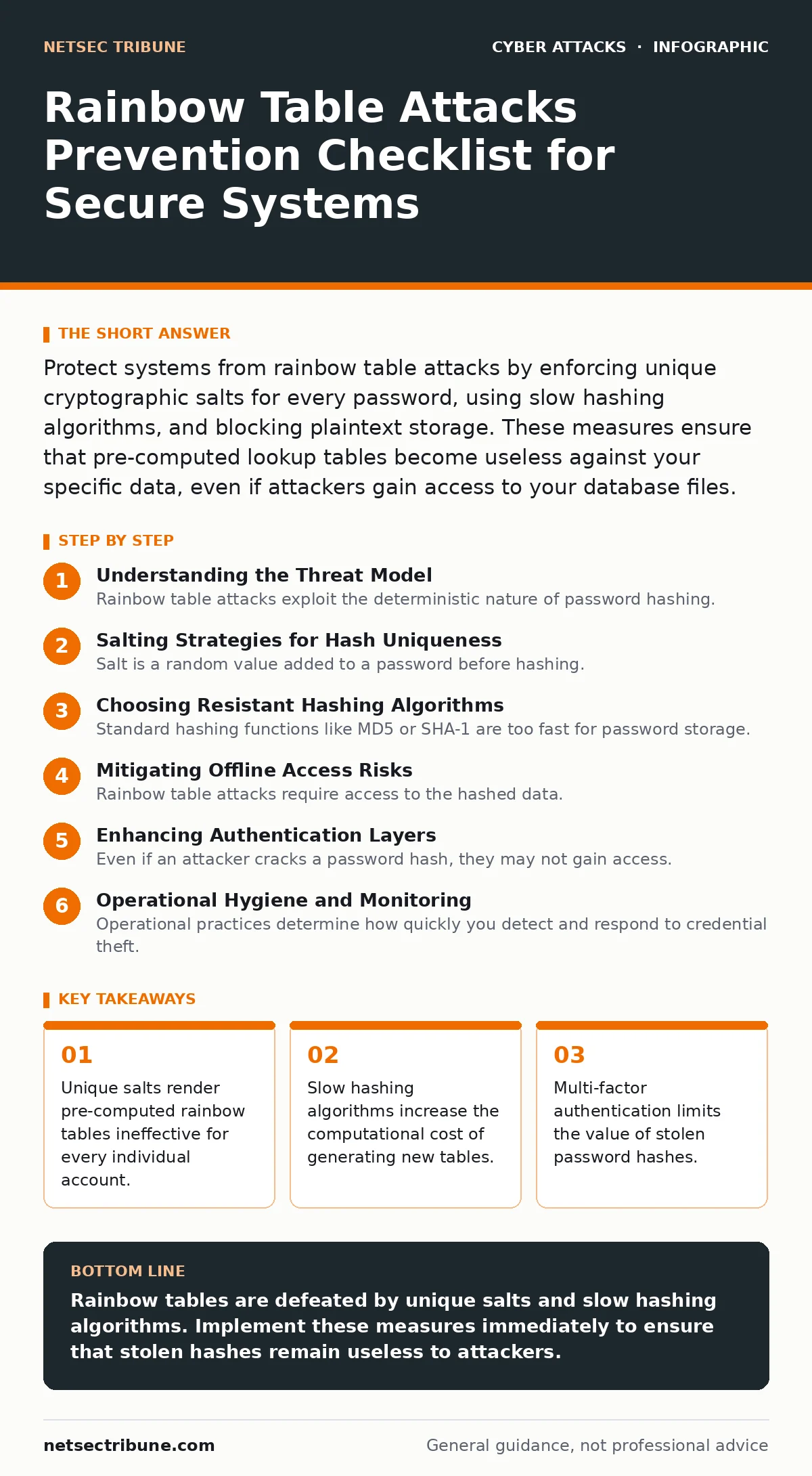
Protect systems from rainbow table attacks by enforcing unique cryptographic salts for every password, using slow hashing algorithms, and blocking plaintext storage. These measures ensure that pre-computed lookup tables become useless against your specific data, even if attackers gain access to your database files.
Understanding the Threat Model
Rainbow table attacks exploit the deterministic nature of password hashing. Attackers build massive databases that map hash values back to their original passwords. This process happens offline, before the attacker ever touches your system. The attack succeeds when an adversary steals a database containing hashed credentials and matches those hashes against their pre-computed tables.
This method bypasses the time constraints of online brute-force attacks. Online attempts trigger account lockouts and detection systems. Offline attacks allow adversaries to test billions of guesses without alerting your monitoring tools. The speed of the attack depends entirely on the size of the rainbow table and the speed of the lookup process.
Salting Strategies for Hash Uniqueness
Salt is a random value added to a password before hashing. This ensures that identical passwords produce different hash outputs. Without salt, an attacker can use a single rainbow table to crack millions of accounts simultaneously. With unique salts, the attacker must generate a separate table for every single user.
- Generate cryptographically random salts for each password: ensures no two hashes are identical even for duplicate passwords.
- Store salts alongside the hash in the database: allows the system to verify passwords without storing the salt separately.
- Use salt lengths of at least 128 bits: prevents attackers from using fixed-length assumptions to optimize their table generation.
- Avoid using usernames or email addresses as salts: these values are often public knowledge and do not add entropy.
Choosing Resistant Hashing Algorithms
Standard hashing functions like MD5 or SHA-1 are too fast for password storage. Their speed benefits attackers building rainbow tables. You must use algorithms designed to be computationally expensive. These algorithms intentionally consume memory and processing power, making it impractical to pre-compute large tables.
- Implement Argon2id for new systems: this algorithm resists both GPU and ASIC-based attacks by requiring significant memory.
- Use bcrypt with a high work factor: this increases the time required to compute each hash, slowing down table generation.
- Configure PBKDF2 with at least 100,000 iterations: this legacy standard remains viable if configured with a high iteration count.
- Disable support for legacy hashing algorithms: removing old options prevents accidental storage of weak hashes.
Mitigating Offline Access Risks
Rainbow table attacks require access to the hashed data. If an attacker cannot steal the database, they cannot use the tables. Defense in depth focuses on limiting the blast radius of any potential breach. Restricting access to the credential store reduces the likelihood of data exfiltration.
- Encrypt the database at rest: ensures that stolen disk images do not reveal readable hash values.
- Restrict database access to application services only: prevents direct queries from external systems or compromised web shells.
- Monitor for unusual data export patterns: detects bulk reads that may indicate an attempt to steal the credential table.
- Segment the authentication database from other services: isolates credential data from general application databases.
Enhancing Authentication Layers
Even if an attacker cracks a password hash, they may not gain access. Multi-factor authentication adds a layer that rainbow tables cannot bypass. Passwords alone are insufficient for high-value accounts. Combining passwords with something the user possesses or is creates a barrier that hash cracking cannot overcome.
- Enforce multi-factor authentication for all privileged accounts: prevents access even if the password hash is successfully reversed.
- Deploy passkeys for user login: eliminates the need to store password hashes entirely, removing the attack vector.
- Implement adaptive authentication policies: triggers additional verification steps when login patterns deviate from the norm.
- Disable password-based login for service accounts: forces the use of certificates or tokens that are not susceptible to hash cracking.
Operational Hygiene and Monitoring
Operational practices determine how quickly you detect and respond to credential theft. Regular audits ensure that configurations remain secure. Monitoring for specific indicators of compromise helps identify attempts to use stolen hashes. Proactive maintenance prevents the accumulation of weak credentials.
- Audit password policies for minimum complexity: ensures that passwords are long enough to make rainbow table generation impractical.
- Monitor for repeated failed login attempts: identifies potential online brute-force attacks that may precede offline analysis.
- Rotate credentials after any suspected database breach: invalidates existing hashes and forces attackers to start over.
- Review third-party access to authentication systems: ensures that external vendors cannot export or access hashed credentials.
Integrating with Broader Security Controls
Rainbow table prevention is one part of a larger security strategy. It works best when combined with other defensive measures. For example, protecting against clone phishing reduces the risk of users reusing passwords across sites. Similarly, defending against session hijacking ensures that stolen credentials do not grant immediate access.
Consider how DDoS protection might distract from credential theft attempts. Attackers may flood your systems to mask data exfiltration. Understanding the blast radius of a credential leak helps prioritize remediation efforts. Refer to our guide on passkeys for a modern alternative to password storage. Also review our coverage of botnet attacks to understand distributed cracking risks.
Key takeaways
- Unique salts render pre-computed rainbow tables ineffective for every individual account.
- Slow hashing algorithms increase the computational cost of generating new tables.
- Multi-factor authentication limits the value of stolen password hashes.
Rainbow tables are defeated by unique salts and slow hashing algorithms. Implement these measures immediately to ensure that stolen hashes remain useless to attackers.
Frequently asked questions
Do salted passwords completely stop rainbow table attacks?
Yes, unique salts force attackers to build a new table for each user, which is computationally infeasible for large datasets.
Can I use my own custom salt generation method?
No, custom methods often introduce biases or weaknesses. Use standard cryptographic libraries to generate random salts.
How do I know if my system is vulnerable?
Check if your passwords are hashed without unique salts or if you use fast algorithms like MD5 or SHA-1.
Is multi-factor authentication enough if I have weak hashing?
It helps, but weak hashing still exposes user privacy and allows attackers to pivot to other systems where the same password is used.
How this guide was produced: written by the NetSec Tribune editorial team with AI assistance, checked against the public references listed below, and reviewed when the facts change. See our editorial policy or report an error.