
SaaS Account Takeover Mistakes That Leave Your Organization Exposed
Default SaaS settings and weak identity policies create silent entry points that attackers exploit long before any network perimeter is breached.
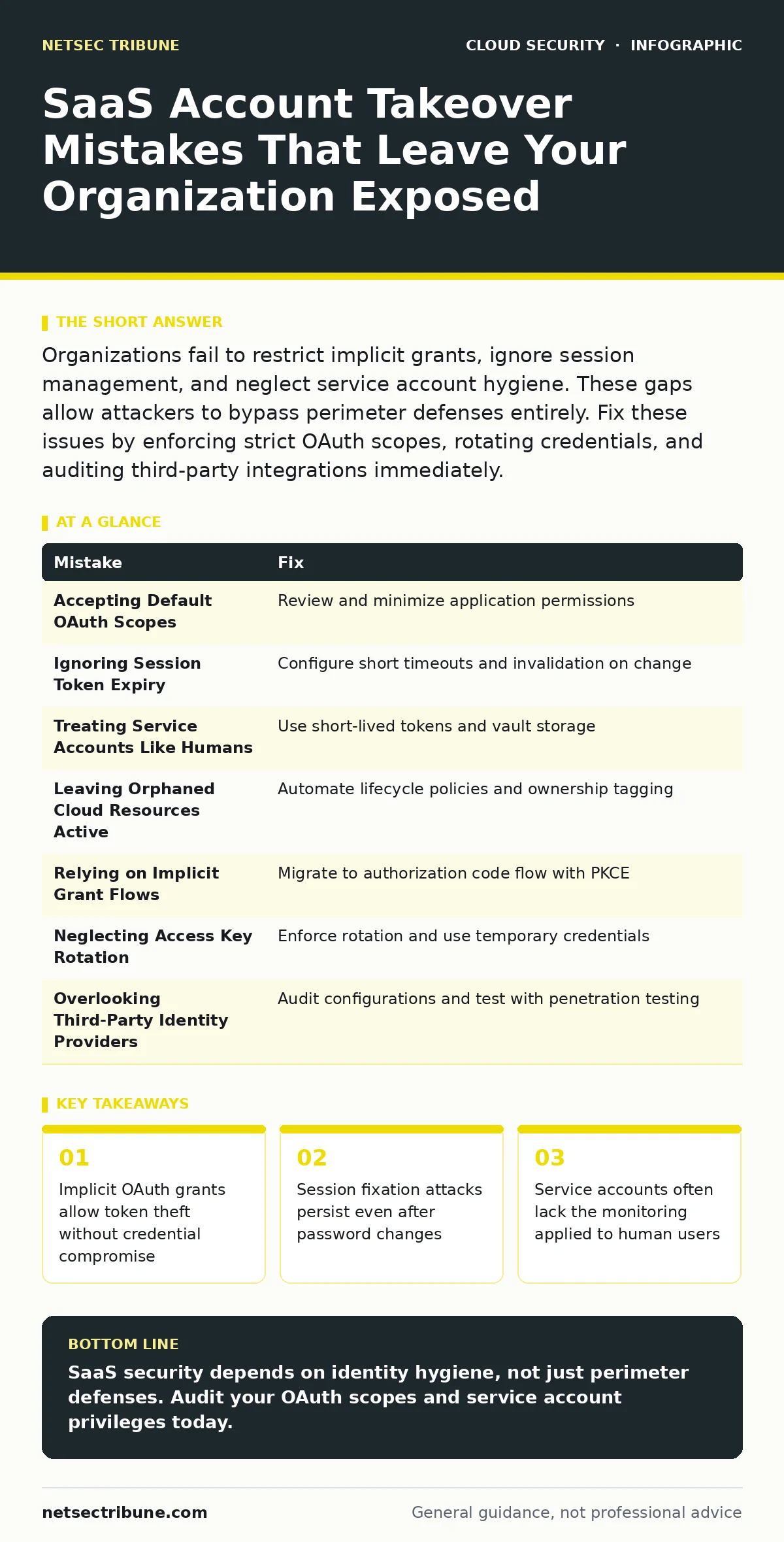
Organizations fail to restrict implicit grants, ignore session management, and neglect service account hygiene. These gaps allow attackers to bypass perimeter defenses entirely. Fix these issues by enforcing strict OAuth scopes, rotating credentials, and auditing third-party integrations immediately.
Mistake 1: Accepting Default OAuth Scopes
Application developers often request maximum permissions during integration setup. The organization grants these permissions without reviewing the specific data access levels. This creates a wide attack surface where a compromised app can access far more data than required.
Why it hurts:
An attacker who compromises a third-party application gains the same broad access as the original admin. The attacker does not need to guess passwords or bypass multi-factor authentication. They simply use the stolen access token to exfiltrate data or modify settings. The scope of damage is limited only by the initial permission grant, not by the attacker’s skill level.
The fix:
Review every connected application in your identity provider settings. Remove any application that is not actively used. For active applications, reduce permissions to the minimum required for function. Implement a policy that requires justification for any new high-privilege scope request. Regular audits prevent permission creep over time.
Mistake 2: Ignoring Session Token Expiry
Many SaaS platforms issue long-lived session tokens for user convenience. Administrators often leave these default settings unchanged because they prioritize user experience over security. This practice assumes that the network perimeter protects the session, which is rarely true in modern cloud environments.
Why it hurts:
If an attacker intercepts a valid session token, they can impersonate the user for the entire token lifespan. Changing the user password does not invalidate the existing session. The attacker maintains access until the token naturally expires or the user manually logs out. This window allows silent data theft without triggering login alerts.
The fix:
Configure short session timeout values in your identity provider. Enable session invalidation on password change or privilege escalation. Monitor for impossible travel scenarios where a user logs in from two distant locations within minutes. These controls ensure that stolen credentials become useless quickly.
Mistake 3: Treating Service Accounts Like Human Users
Service accounts are automated identities used for API integrations and background tasks. Teams often create these accounts with human-like credentials and weak monitoring. They assume that because no human logs in, the account is less likely to be targeted by phishing or social engineering.
Why it hurts:
Service accounts rarely have multi-factor authentication enabled. Attackers target these accounts because they bypass MFA challenges entirely. Once a service account credential is stolen, the attacker can automate data exfiltration at scale. The lack of interactive login alerts means the breach may go unnoticed for weeks or months.
The fix:
Use application-specific secrets or short-lived tokens instead of long-term passwords for service accounts. Store these credentials in a secure vault, not in code repositories. Implement strict IP allow-listing for service account access. Monitor for unusual API call volumes or access from unexpected geographies. This approach limits the blast radius of a compromise.
Mistake 4: Leaving Orphaned Cloud Resources Active
When employees leave or projects end, associated cloud resources are often not decommissioned. This includes unused storage buckets, inactive user accounts, and dormant virtual machines. These orphaned cloud resources remain accessible to anyone who discovers their identifiers.
Why it hurts:
Attackers scan public directories for exposed storage and inactive endpoints. An orphaned resource may contain sensitive data or provide a foothold for lateral movement. The organization pays for these resources while they serve as free intelligence for adversaries. Cleanup processes that ignore these assets leave a persistent trail of vulnerabilities.
The fix:
Implement automated lifecycle policies for cloud resources. Tag all assets with ownership and expiration dates. Regularly audit for resources without active owners and decommission them. This practice reduces cost and eliminates easy targets for reconnaissance. Consistent cleanup is a fundamental part of cloud hygiene.
Mistake 5: Relying on Implicit Grant Flows
Older OAuth implementations use the implicit grant flow, which returns access tokens directly to the browser. Modern best practices have moved away from this method due to its inherent risks. Many legacy applications still use implicit grants because migrating to newer flows requires development effort.
Why it hurts:
Tokens returned via implicit grants are exposed in browser history and server logs. An attacker with access to the user’s browser or browser extensions can easily extract these tokens. Cross-site scripting attacks become significantly more effective against applications using this flow. The token theft happens silently, without any login attempt that might trigger an alert.
The fix:
Migrate all applications to the authorization code flow with PKCE. PKCE adds a cryptographic verifier that prevents token interception. This standard is supported by major identity providers and requires minimal changes to existing infrastructure. Enforce this standard in your security policy for all new integrations.
See also: Serverless Security Myths: Why Code Is Not Enough
Mistake 6: Neglecting Access Key Rotation
Long-term access keys are often created for scripting or legacy integrations and then forgotten. Teams assume that because the key is not used daily, it does not pose an immediate risk. This assumption fails when attackers discover these keys in public code repositories or configuration files.
Why it hurts:
Stale access keys represent a persistent backdoor into your environment. Attackers can use these keys to pivot between services or escalate privileges. The lack of recent usage makes the activity blend into normal background noise. Without regular rotation, a compromised key remains valid indefinitely.
The fix:
Enforce mandatory access key rotation policies. Use temporary credentials generated through federated identity where possible. Monitor for unused keys and disable them after a set period. Integrate this process into your regular security audits. This practice ensures that any leaked credentials have a limited window of usefulness.
Mistake 7: Overlooking Third-Party Identity Providers
Organizations often trust third-party identity providers to handle authentication security. They assume that the provider’s security posture is sufficient to protect their own accounts. This trust is misplaced because misconfigurations on the provider side can still impact your tenant.
Why it hurts:
A misconfiguration in the identity provider can expose user attributes or allow unauthorized token issuance. Attackers exploit these gaps to gain initial access to your SaaS applications. The breach origin is outside your direct control, making detection and response difficult. You remain liable for the data exposure regardless of where the failure occurred.
The fix:
Regularly audit your identity provider configuration against established standards. Review the CIS Benchmarks for your specific provider to identify common misconfigurations. Test your identity assertions with cloud penetration testing to validate security controls. Treat the identity provider as part of your security perimeter, not an external black box.
| Mistake | Fix |
|---|---|
| Accepting Default OAuth Scopes | Review and minimize application permissions |
| Ignoring Session Token Expiry | Configure short timeouts and invalidation on change |
| Treating Service Accounts Like Humans | Use short-lived tokens and vault storage |
| Leaving Orphaned Cloud Resources Active | Automate lifecycle policies and ownership tagging |
| Relying on Implicit Grant Flows | Migrate to authorization code flow with PKCE |
| Neglecting Access Key Rotation | Enforce rotation and use temporary credentials |
| Overlooking Third-Party Identity Providers | Audit configurations and test with penetration testing |
Key takeaways
- Implicit OAuth grants allow token theft without credential compromise
- Session fixation attacks persist even after password changes
- Service accounts often lack the monitoring applied to human users
- Orphaned cloud resources provide lateral movement paths after initial access
SaaS security depends on identity hygiene, not just perimeter defenses. Audit your OAuth scopes and service account privileges today.
Frequently asked questions
Does multi-factor authentication prevent SaaS account takeover?
MFA protects against password theft but does not stop attackers who steal valid session tokens or compromise service accounts. You must also manage token lifespans and credential storage.
How often should I rotate service account credentials?
Rotate credentials every 90 days or immediately if unusual activity is detected. Use short-lived tokens generated on demand to eliminate the need for long-term secret storage.
What is the difference between implicit and authorization code flows?
Implicit flow exposes tokens in the browser, making them vulnerable to theft. Authorization code flow uses a server-side exchange, keeping tokens secure and preventing interception.
Can third-party apps still access data after they are removed?
Removing an app revokes its access, but any previously stolen tokens may remain valid until they expire. You must actively revoke all active sessions and tokens for disconnected applications.
How this guide was produced: written by the NetSec Tribune editorial team with AI assistance, checked against the public references listed below, and reviewed when the facts change. See our editorial policy or report an error.