
MITRE ATT&CK vs Cyber Kill Chain: Structural Differences and Use Cases
The Cyber Kill Chain stops at initial compromise, while MITRE ATT&CK maps the entire post-breach lifecycle, revealing lateral movement and data exfiltration paths that earlier models ignore.
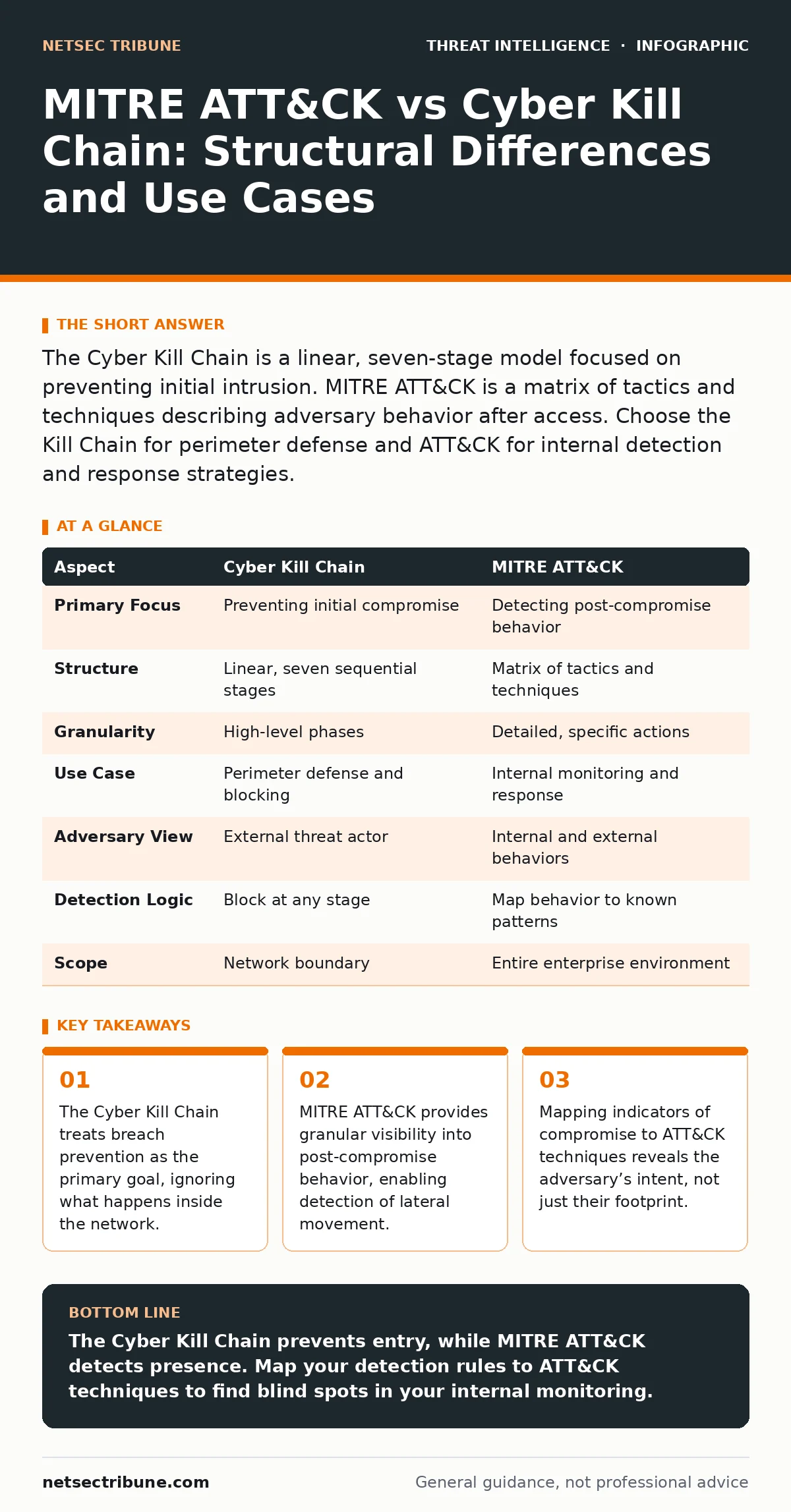
The Cyber Kill Chain is a linear, seven-stage model focused on preventing initial intrusion. MITRE ATT&CK is a matrix of tactics and techniques describing adversary behavior after access. Choose the Kill Chain for perimeter defense and ATT&CK for internal detection and response strategies.
The Linear Limitation of the Kill Chain
The Cyber Kill Chain models an attack as a straight line from reconnaissance to objective achievement. It assumes that stopping an adversary at any stage prevents the ultimate breach. This model was designed primarily for network perimeter defense. It works well for blocking external threats before they enter your environment.
However, it fails to account for scenarios where the adversary has already gained access. Once inside, the linear steps of the Kill Chain no longer apply. The model does not describe how an attacker moves laterally or persists within your systems. This gap leaves security teams blind to internal threats that have bypassed the initial gates.
The Behavioral Depth of MITRE ATT&CK
MITRE ATT&CK is a knowledge base of adversary tactics and techniques based on real-world observations. It does not assume a linear progression. Instead, it catalogs the methods attackers use to achieve specific goals, such as privilege escalation or data exfiltration.
This framework focuses on the "how" rather than the "when". It allows you to map observed behaviors to known techniques. This mapping helps you understand the adversary’s intent. You can identify gaps in your detection capabilities by seeing which techniques you monitor and which you miss.
Structural Comparison
The two frameworks serve different purposes in your security architecture. One focuses on prevention at the edge, while the other focuses on detection and response throughout the environment. Understanding their structural differences helps you apply the right tool to the right problem.
| Aspect | Cyber Kill Chain | MITRE ATT&CK |
|---|---|---|
| Primary Focus | Preventing initial compromise | Detecting post-compromise behavior |
| Structure | Linear, seven sequential stages | Matrix of tactics and techniques |
| Granularity | High-level phases | Detailed, specific actions |
| Use Case | Perimeter defense and blocking | Internal monitoring and response |
| Adversary View | External threat actor | Internal and external behaviors |
| Detection Logic | Block at any stage | Map behavior to known patterns |
| Scope | Network boundary | Entire enterprise environment |
Choosing the Right Framework
Selecting between these models depends on your specific security objective. Neither framework is superior in all contexts. Each excels in different phases of the security lifecycle.
Choose the Cyber Kill Chain when:
- You are designing perimeter defenses.
- You need a simple model for explaining basic threat concepts.
- Your primary concern is blocking initial access from external sources.
- You are analyzing threat intelligence feeds for early-stage indicators.
Choose MITRE ATT&CK when:
- You are building detection rules for internal network traffic.
- You want to understand how an adversary moves after gaining access.
- You are conducting purple teaming to test detection capabilities.
- You need to map indicators of compromise to specific adversary behaviors.
Where the Models Overlap
The overlap occurs at the initial access phase. Both frameworks recognize that an attacker must first find a way in. Techniques for phishing, exploiting vulnerabilities, or using initial access brokers appear in both models.
However, the Kill Chain stops here. It considers the breach successful if the adversary achieves objectives. ATT&CK continues to map the subsequent actions. This distinction is critical for modern security operations. You must defend the perimeter, but you must also assume breach.
See also: Threat Actor Profiling: 6 Common Misreadings and Correct Views
The Hidden Cost of Linear Thinking
Relying solely on the Cyber Kill Chain creates a false sense of security. It implies that if you stop the attack at stage four, you are safe. This ignores the reality of advanced persistent threats. These adversaries often operate for months before detection.
They use techniques that do not fit the linear model. For example, an attacker might use domain generation algorithms to communicate with their command and control server. This activity occurs well after the initial compromise. The Kill Chain does not provide a framework for detecting this behavior.
Integrating Both for Defense in Depth
You do not need to choose one framework over the other. They complement each other in a mature security program. Use the Cyber Kill Chain to harden your perimeter. Use MITRE ATT&CK to monitor your internal environment.
This dual approach covers both prevention and detection. It allows you to address threats at every stage. You can block external attacks while simultaneously hunting for internal anomalies. This integration is key to reducing your overall risk exposure.
Practical Application in Operations
Start by mapping your current security controls to the Cyber Kill Chain. Identify which stages you protect well and which are weak. Then, expand your view using MITRE ATT&CK. Map your detection capabilities to the techniques listed in the framework.
This exercise reveals gaps in your visibility. You may find that you detect initial access but miss lateral movement. Addressing these gaps improves your overall security posture. It ensures that you can respond to threats regardless of where they originate.
Key takeaways
- The Cyber Kill Chain treats breach prevention as the primary goal, ignoring what happens inside the network.
- MITRE ATT&CK provides granular visibility into post-compromise behavior, enabling detection of lateral movement.
- Mapping indicators of compromise to ATT&CK techniques reveals the adversary’s intent, not just their footprint.
The Cyber Kill Chain prevents entry, while MITRE ATT&CK detects presence. Map your detection rules to ATT&CK techniques to find blind spots in your internal monitoring.
Frequently asked questions
Can I use the Cyber Kill Chain for incident response?
It provides a basic timeline, but it lacks the detail needed for effective response. Use MITRE ATT&CK for deeper analysis of adversary behavior.
Is MITRE ATT&CK too complex for small teams?
It can be, but you can start by focusing on high-impact techniques. Prioritize mapping your most critical assets to relevant tactics.
How do I map indicators of compromise to these frameworks?
IOCs map to Kill Chain stages. For ATT&CK, map the behavior associated with the IOC to specific techniques for better context.
Do these frameworks cover insider threats?
The Kill Chain does not. MITRE ATT&CK includes techniques relevant to insider threats, such as unauthorized access and data exfiltration.
How this guide was produced: written by the NetSec Tribune editorial team with AI assistance, checked against the public references listed below, and reviewed when the facts change. See our editorial policy or report an error.