
Digital forensics and incident response training benefits and limits
Realistic training builds muscle memory for root-cause analysis, but manufactured lab environments rarely match messy production reality.
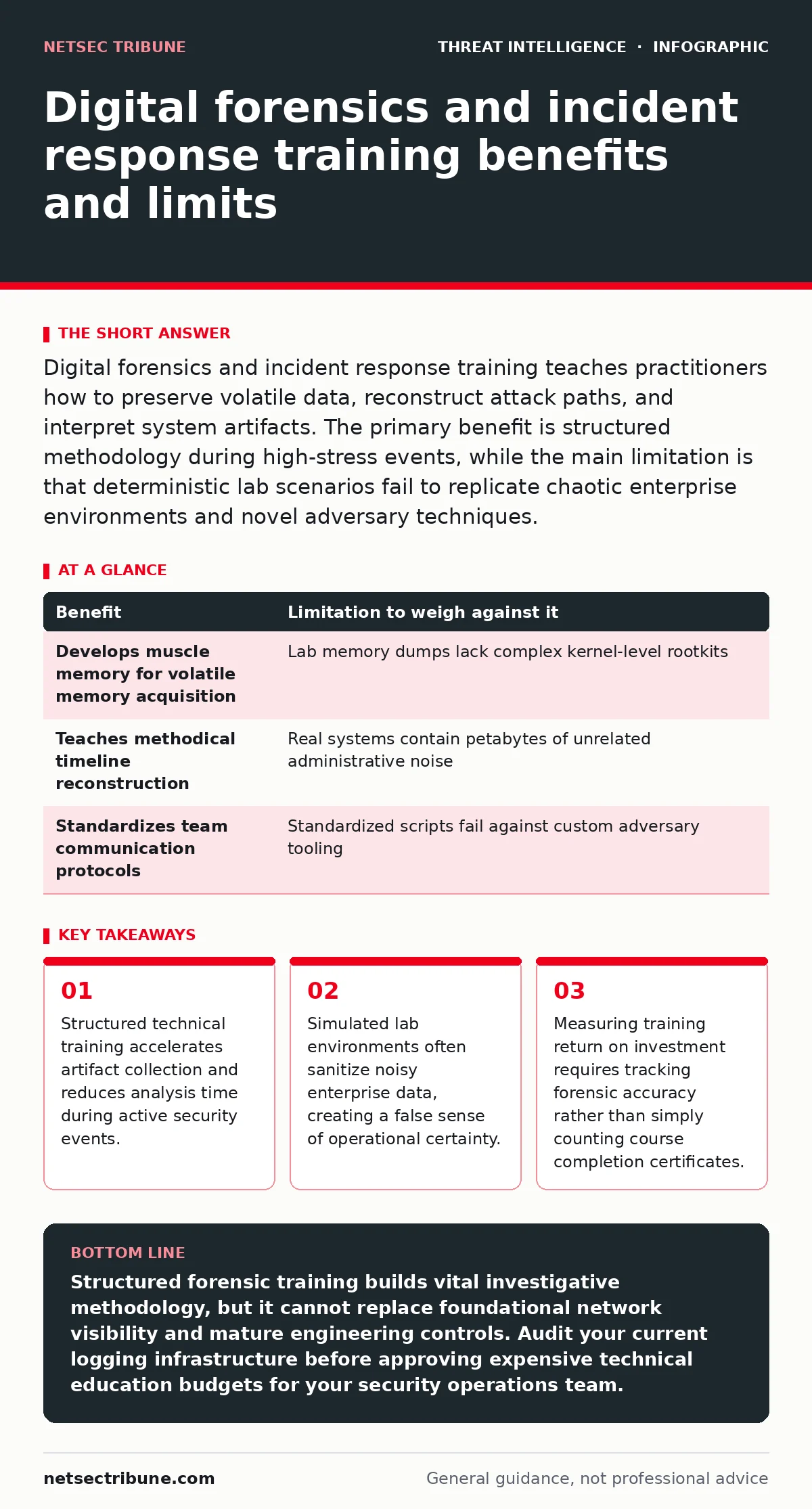
Digital forensics and incident response training teaches practitioners how to preserve volatile data, reconstruct attack paths, and interpret system artifacts. The primary benefit is structured methodology during high-stress events, while the main limitation is that deterministic lab scenarios fail to replicate chaotic enterprise environments and novel adversary techniques.
Core advantages of structured investigation drills
Digital forensics and incident response training provides repeatable frameworks for examining compromised hosts and networks. Practitioners learn how to acquire volatile memory, parse file system journals, and construct chronological timelines of malicious activity. This procedural grounding helps investigators avoid panic when confronting unfamiliar operating system states. Without formal training, analysts often rely on ad-hoc intuition, which introduces cognitive biases and leads to missed evidence during crucial preservation phases.
Structured drills also teach teams how to separate genuine indicators of compromise from normal administrative noise. Investigators practice identifying unauthorized persistence mechanisms and unauthorized lateral movement techniques across different enterprise architectures. This repetition builds operational muscle memory, allowing personnel to execute containment commands quickly when seconds matter.
Hidden friction and operational limitations
Simulated training scenarios frequently suffer from artificial cleanliness that rarely exists in production environments. Instructors design labs with neat entry points and obvious forensic artifacts, which trains investigators to look for predictable breadcrumbs. Real adversaries often employ stealth tactics, log manipulation, and living-off-the-land binaries that leave ambiguous traces across multiple fragmented data sources.
Another drawback involves skill decay when acquired techniques are not applied immediately in daily operations. Personnel frequently forget specific command syntax or file format structures within months of completing a course unless their routine duties involve active investigations. Training budgets can thus become recurring expenses with diminishing returns if the organizational environment lacks enough actual incidents to maintain sharp investigative reflexes.
| Benefit | Limitation to weigh against it |
|---|---|
| Develops muscle memory for volatile memory acquisition | Lab memory dumps lack complex kernel-level rootkits |
| Teaches methodical timeline reconstruction | Real systems contain petabytes of unrelated administrative noise |
| Standardizes team communication protocols | Standardized scripts fail against custom adversary tooling |
When forensic readiness education pays off
Digital forensics and incident response training becomes valuable when an organization has already established baseline asset visibility and logging hygiene. Teams benefit immensely from advanced instruction once they possess the foundational engineering maturity to capture reliable telemetry across endpoints and cloud environments. Training bridges the gap between raw data collection and meaningful attribution, helping analysts pivot from simple alert triage to deep root-cause analysis.
Organizations scaling their internal security operations also gain high value from standardized team training. When every investigator follows the same chain-of-custody procedures and evidentiary standards, cross-functional handoffs become smoother during multi-system intrusions. This consistency prevents crucial artifacts from being mishandled or accidentally overwritten by well-meaning system administrators during remediation.
When skill acquisition fails to deliver value
Training investments yield poor results when an organization lacks basic network segmentation and centralized log retention. Sending analysts to advanced memory analysis courses makes little financial sense if the enterprise cannot reliably tell which workstations exist on the local network. Investigators cannot perform effective forensic triage if their primary data sources consist of overwritten disk drives and missing event logs.
Another scenario where formal training falters involves high-turnover environments where newly skilled personnel leave shortly after completing expensive certification programs. Organizations that treat education as a substitute for fixing fundamental architectural vulnerabilities will continue to suffer chronic breaches regardless of how many advanced badges their staff accumulates.
Unanticipated consequences of standardized curricula
Standardized curricula often condition investigators to follow rigid decision trees, which can hinder adaptability when facing novel attack vectors. Real adversaries constantly modify their methods to evade signature-based detection, requiring intuitive leaps that checklist-driven training discourages. Analysts trained strictly on historical case studies may misidentify an ongoing intrusion if the threat actor uses unexpected protocols or non-standard persistence techniques.
Furthermore, intense focus on deep forensic analysis can create institutional bottlenecks during active containment. An investigator obsessed with preserving every bit of a compromised hard drive for courtroom-grade chain of custody might delay the rapid isolation needed to stop data exfiltration. Effective operational response requires balancing forensic thoroughness with business continuity imperatives.
See also: Difference Between Cloud Logging and Monitoring: Operational Reality · Decoding Ransom Notes: Evidence Handling and Negotiation Realities
Assessing training investments through realistic metrics
Measuring the true value of investigative education requires tracking qualitative improvements in incident handling rather than counting hours spent in virtual classrooms. Effective evaluation involves conducting unannounced internal red team assessments to see if trained staff can independently discover hidden persistence mechanisms within realistic timeframes. Organizations should also audit past incident reports to determine whether post-training investigations yield more complete scopes and faster eradication times.
Budget allocation should prioritize continuous practical exercises over one-off certification bootcamps that focus primarily on multiple-choice examinations. Building internal lab ranges that mirror the exact software stack of the production enterprise provides much higher fidelity than generic cloud-based training environments populated by pristine, textbook artifacts.
Key takeaways
- Structured technical training accelerates artifact collection and reduces analysis time during active security events.
- Simulated lab environments often sanitize noisy enterprise data, creating a false sense of operational certainty.
- Measuring training return on investment requires tracking forensic accuracy rather than simply counting course completion certificates.
Structured forensic training builds vital investigative methodology, but it cannot replace foundational network visibility and mature engineering controls. Audit your current logging infrastructure before approving expensive technical education budgets for your security operations team.
Frequently asked questions
How often should security analysts refresh their digital forensics skills?
Active investigators should engage in hands-ad-hoc lab practice continuously and formal advanced training every couple of years to keep pace with evolving operating system internals and adversary evasion techniques.
Can open-source resources replace paid digital forensics training courses?
Public documentation, community-driven challenges, and open-source forensic frameworks provide adequate technical foundations for self-motivated practitioners, though paid courses often package this knowledge into structured, time-efficient formats.
What role do certifications play in evaluating forensic readiness?
Certifications demonstrate baseline theoretical knowledge and dedication, but they do not guarantee an analyst can successfully navigate the messy, incomplete telemetry of a real enterprise compromise.
How do you justify the cost of incident response training to leadership?
Frame the investment around reduced dwell time and minimized business disruption during a security event, supported by metrics showing faster containment times achieved by trained personnel.
How this guide was produced: written by the NetSec Tribune editorial team with AI assistance, checked against the public references listed below, and reviewed when the facts change. See our editorial policy or report an error.