
Dark web search engines and how hidden indexes actually work
Dark web search engines do not crawl hidden sites like public ones do, relying instead on static directories and user submissions.
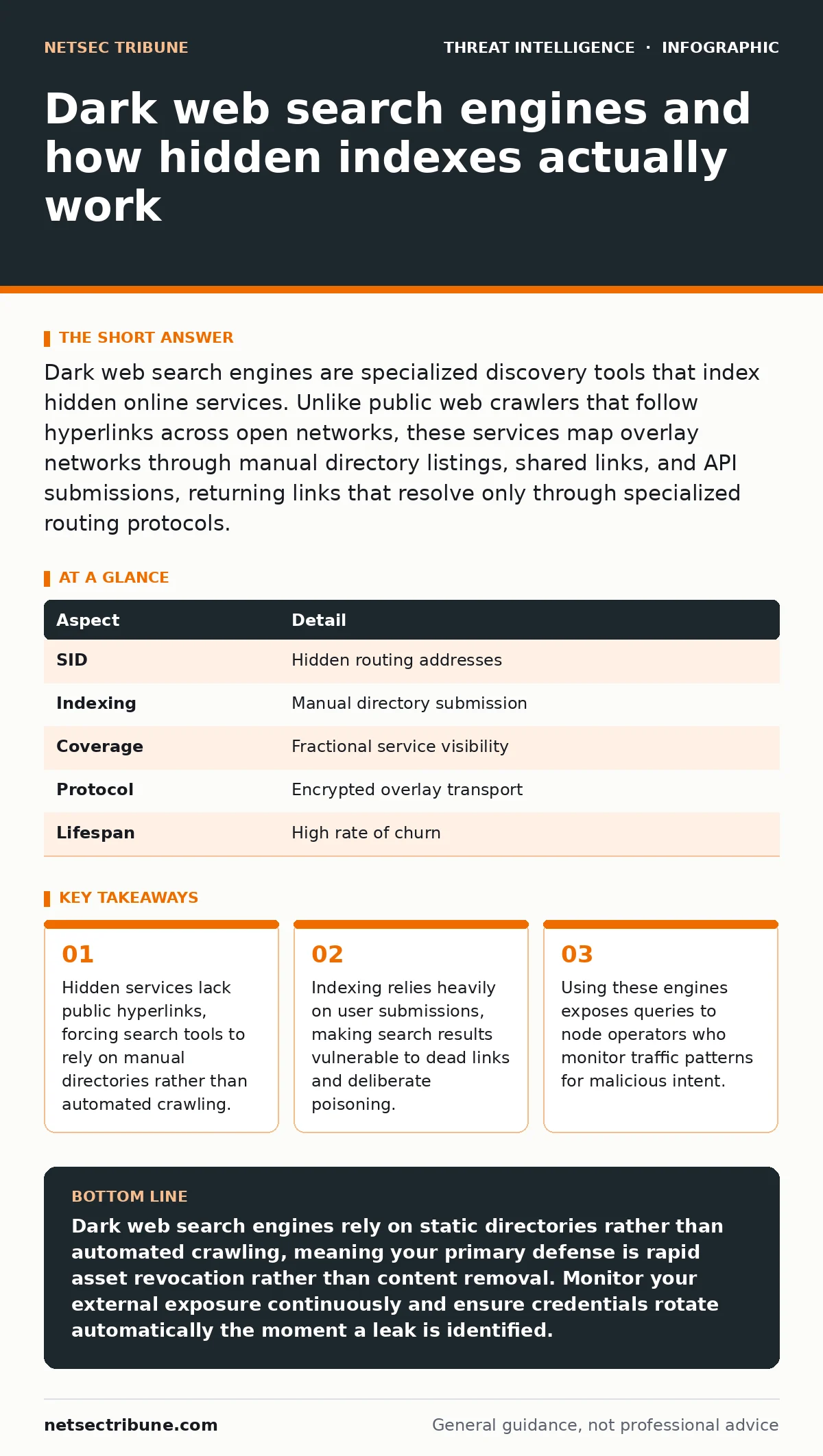
Dark web search engines are specialized discovery tools that index hidden online services. Unlike public web crawlers that follow hyperlinks across open networks, these services map overlay networks through manual directory listings, shared links, and API submissions, returning links that resolve only through specialized routing protocols.
What are dark web search engines
Dark web search engines are specialized discovery platforms designed to index and retrieve content hosted on overlay networks that require specific routing software to access. Unlike traditional search platforms that continuously crawl the public internet by following automated hyperlinks, these tools index hidden services through static directories, API submissions, and user-generated link collections.
Hidden services do not link to one another openly to preserve anonymity, which breaks the automated discovery model used by public web crawlers. Consequently, search engines for overlay networks function more like early web directories from the nineties, relying on manual categorization and static databases rather than real-time link analysis. This structural limitation means search coverage remains fractional, often capturing only a small fraction of the total active hidden infrastructure at any given time.
| Aspect | Detail |
|---|---|
| SID | Hidden routing addresses |
| Indexing | Manual directory submission |
| Coverage | Fractional service visibility |
| Protocol | Encrypted overlay transport |
| Lifespan | High rate of churn |
How dark web search indexing happens
Dark web search indexing happens through static cataloging and direct user submissions rather than automated link traversal. Automated crawlers fail on overlay networks because hidden services frequently require authentication, lack inbound links from other sites, and intentionally drop traffic from unknown scrapers to prevent deanonymization.
Engine operators bypass these hurdles by offering web forms where site owners can submit new hidden addresses for inclusion. Some engines deploy custom scanning scripts designed to connect to specific ports on known overlay addresses, but these scripts hit strict rate limits to avoid triggering network defenses. This manual and semi-automated approach creates significant lag between a service launching and appearing in search results.
Who is affected by hidden index visibility
Security operations teams and corporate defenders are affected by hidden index visibility because exposed internal assets, stolen credentials, and leaked proprietary documents frequently appear in these directories before attackers leverage them in campaigns. When an organization suffers a data leak, the offending material often gets indexed by multiple competing search engines within hours of publication on an illicit marketplace or forum.
Defenders monitor these search engines to detect stolen assets early, but this process carries operational trade-offs. Automated querying of hidden search platforms generates predictable request patterns that malicious operators can log, potentially alerting threat actors to defensive interest.
Common forms of search platforms
Common forms of search platforms on overlay networks range from simple text-matching directories to experimental semantic indexing tools. Simple keyword indexes operate much like early public search tools, matching exact strings against page titles and meta descriptions provided by the site administrator during submission.
Advanced platforms attempt to parse unstructured text across forums and marketplaces, grouping discussions related to specific malware families or zero-day exploits. However, these complex platforms suffer from high rates of false positives because hidden content frequently uses slang, obfuscation, and intentionally misleading nomenclature designed to confuse automated parsers.
Hidden costs and edge cases of search tools
Hidden costs of using these search tools include compromised metadata, traffic analysis exposure, and high rates of poisoned search results. When you execute a query on a hidden search engine, the operator of that engine sees your source routing circuit and search terms, creating a logging risk that malicious entities exploit.
Another non-obvious consequence is index poisoning, where threat actors intentionally flood search engines with broken links, decoy sites, and malware distribution nodes disguised as legitimate file repositories. The transient nature of overlay networks means search engines often display services that went offline weeks prior, wasting analyst time and creating false confidence in negative search results.
See also: Hybrid Warfare in Cyberspace: Correcting 6 Common Intelligence Errors · Indicators of Compromise: 6 Common Misreadings That Fail in Detection
How to reduce the risk of dark web exposure
Reducing the risk of dark web exposure requires proactive asset discovery and monitoring external data leaks before threat actors index them. Organizations should deploy continuous external monitoring to identify unauthorized mentions of intellectual property, executive credentials, and internal infrastructure long before those assets appear in standard hidden search indexes.
When an internal asset is discovered on an overlay network, mitigation involves revoking the compromised resource immediately rather than attempting to remove the listing from the search engine. Search engines cache content aggressively, and takedown requests to hidden index operators are rarely effective, making rapid revocation of the underlying access the only reliable defense.
Key takeaways
- Hidden services lack public hyperlinks, forcing search tools to rely on manual directories rather than automated crawling.
- Indexing relies heavily on user submissions, making search results vulnerable to dead links and deliberate poisoning.
- Using these engines exposes queries to node operators who monitor traffic patterns for malicious intent.
Dark web search engines rely on static directories rather than automated crawling, meaning your primary defense is rapid asset revocation rather than content removal. Monitor your external exposure continuously and ensure credentials rotate automatically the moment a leak is identified.
Frequently asked questions
Can public search engines index dark web sites?
Public search engines cannot index dark web sites because those pages require specialized routing software and cryptographic keys that standard web crawlers do not possess.
Why do dark web search results often contain broken links?
Search results frequently break because hidden services experience high rates of hardware failure, law enforcement seizures, and intentional operator shutdowns that outpace the manual update cycles of the search engines.
Are dark web search queries monitored by malicious actors?
Queries can be logged by the exit nodes, middle relays, and search engine operators themselves, creating potential attribution risks for investigators who fail to isolate their browsing environment.
How do threat actors use search engines on overlay networks?
Adversaries use these engines to locate unregulated communication channels, purchase stolen infrastructure, and research operational security practices used by competing groups.
How this guide was produced: written by the NetSec Tribune editorial team with AI assistance, checked against the public references listed below, and reviewed when the facts change. See our editorial policy or report an error.