
Prevent Race Condition Vulnerabilities in Secure Systems
Most race conditions persist because developers assume operations are atomic when the underlying filesystem or database explicitly allows interleaved execution.
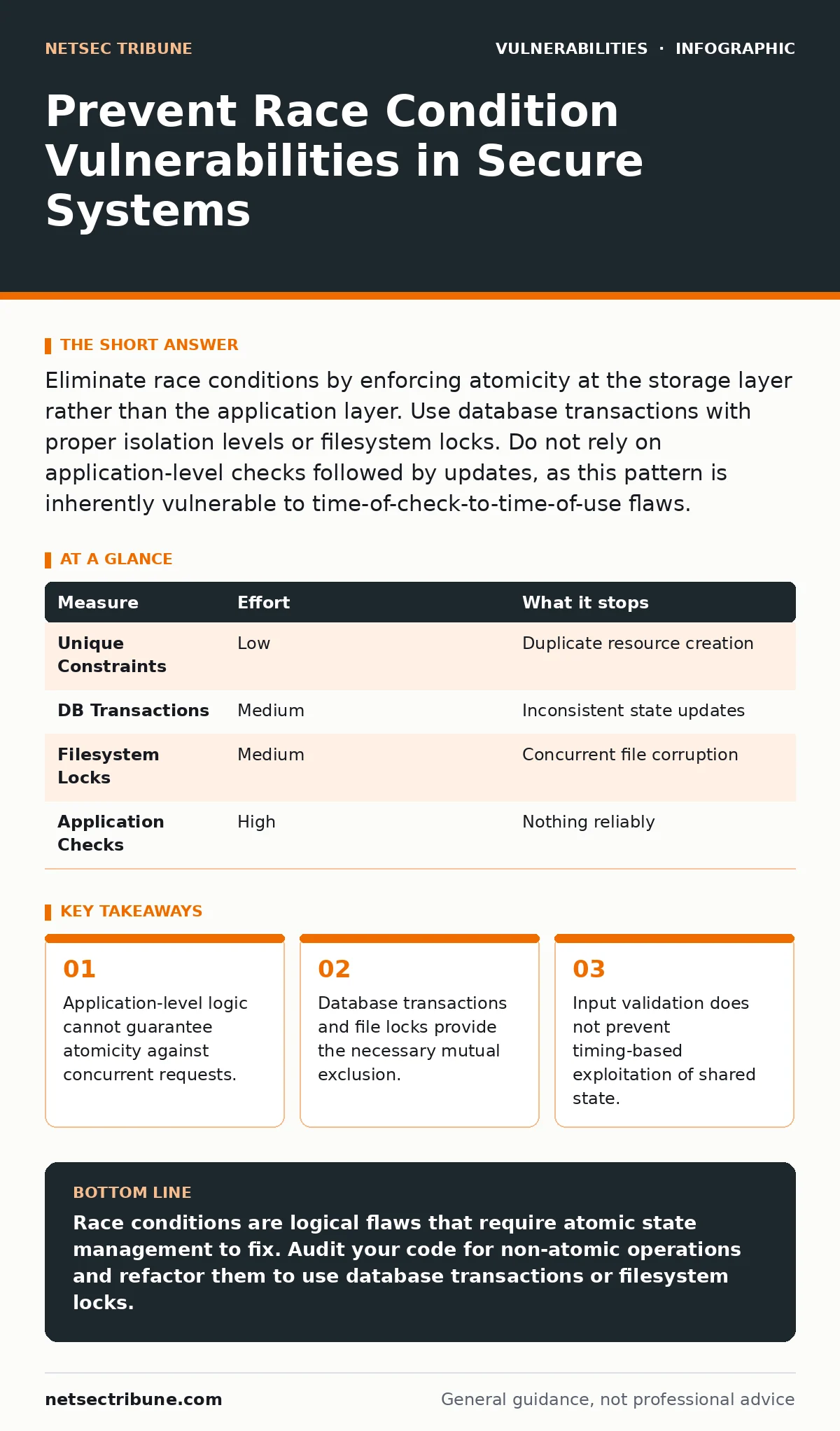
Eliminate race conditions by enforcing atomicity at the storage layer rather than the application layer. Use database transactions with proper isolation levels or filesystem locks. Do not rely on application-level checks followed by updates, as this pattern is inherently vulnerable to time-of-check-to-time-of-use flaws.
The Illusion of Sequential Execution
Race conditions occur when a system’s behavior depends on the relative timing of concurrent events. In software, this usually means two processes access shared data simultaneously. One process modifies the data while the other reads it, or both modify it based on stale information. The result is corrupted state, privilege escalation, or data loss.
These flaws are subtle because they rarely reproduce consistently. They depend on precise timing windows that may exist only under load or specific hardware configurations. This makes them difficult to detect during standard testing. They often remain hidden until an attacker forces the concurrency that triggers the flaw.
Why Application Logic Fails
Developers often attempt to prevent race conditions by adding checks in the application code. A common pattern is to check if a resource exists, then create it. This is known as a time-of-check-to-time-of-use (TOCTOU) flaw. The gap between the check and the use is the window of opportunity.
Imagine a function that checks if a username is taken. If it is not, the function creates the account. Between the check and the creation, another request can slip through. Both requests see the username as available. Both create the account. The system state is now inconsistent.
This failure happens because the application logic is not atomic. Atomicity means an operation either completes entirely or fails entirely, with no intermediate state visible to other processes. Application code running on top of a filesystem or database does not control the underlying storage mechanics. It cannot prevent the storage layer from interleaving operations.
The Power of Database Transactions
The most effective way to prevent race conditions in data-heavy applications is to use database transactions. A transaction groups multiple operations into a single unit of work. The database ensures that either all operations succeed or none do.
You must configure the transaction with the correct isolation level. Read committed isolation prevents dirty reads but allows non-repeatable reads. Serializable isolation prevents all concurrency anomalies but reduces performance. Choose the level that matches your consistency requirements.
Using unique constraints is another powerful database feature. If you define a username column as unique, the database will reject duplicate entries at the storage level. This removes the race condition entirely. The application does not need to check for existence first. It simply attempts the insert and handles the error if it fails.
| Measure | Effort | What it stops |
|---|---|---|
| Unique Constraints | Low | Duplicate resource creation |
| DB Transactions | Medium | Inconsistent state updates |
| Filesystem Locks | Medium | Concurrent file corruption |
| Application Checks | High | Nothing reliably |
Filesystem Locks and Atomic Operations
When you cannot use a database, you must rely on the filesystem. Many developers assume that checking if a file exists is sufficient. It is not. You must use locking mechanisms provided by the operating system.
File locks prevent multiple processes from accessing a file simultaneously. Advisory locks require all processes to cooperate. Mandatory locks are enforced by the kernel but are less portable. Choose the mechanism that your environment supports reliably.
Atomic file operations are another option. Some systems allow you to rename a file only if the destination does not exist. This is an atomic operation provided by the kernel. It eliminates the TOCTOU window. If you must write to a file, write to a temporary file and rename it. This ensures that readers never see a partially written file.
What Does Not Work
Input validation is another ineffective measure. Validating that an input is a valid username does not prevent two valid usernames from being processed simultaneously. The flaw is in the state management, not the input format.
Rate limiting can reduce the frequency of successful exploits. It makes it harder for an attacker to hit the timing window. However, it does not eliminate the vulnerability. A determined attacker can still find the window. Rate limiting is a mitigation, not a fix.
See also: Compensating Controls: When Standard Fixes Fail
Designing for Concurrency
Preventing race conditions requires a shift in design thinking. You must assume that all operations are concurrent. You must assume that the system will be under load. You must design your state management to handle simultaneous access.
Use immutable data structures where possible. If data cannot change, it cannot be corrupted by concurrent writes. Use append-only logs for audit trails. This ensures that history is never overwritten.
Consider using distributed locks for microservices. When multiple services access shared state, they must coordinate. A distributed lock service ensures that only one service holds the lock at a time. This adds complexity but prevents state corruption.
Integrating with Other Security Controls
Race conditions often interact with other vulnerabilities. An attacker might use a race condition to bypass broken access control checks. If the access check is not atomic with the resource access, the attacker can slip through.
They might also use it to exploit mass assignment vulnerabilities. If the system updates multiple fields based on user input, a race condition can allow overwriting critical fields that were intended to be read-only.
Ensure your Content Security Policy does not inadvertently expose endpoints that are vulnerable to race conditions. While CSP prevents injection attacks, it does not protect against logical flaws. You must secure the endpoints themselves.
Immediate Remediation Steps
If you suspect a race condition, do not patch it with application logic. Refactor the code to use atomic operations. Move the logic to the database or filesystem layer.
Test your changes under load. Use concurrency testing tools to simulate multiple simultaneous requests. Verify that the system state remains consistent.
Monitor for anomalous behavior. Look for duplicate records, missing updates, or inconsistent data. These are signs that a race condition may still exist.
Checklist for Today
- Identify all shared state in your application.
- Verify that all updates to shared state are atomic.
- Remove any "check-then-act" patterns in critical paths.
Key takeaways
- Application-level logic cannot guarantee atomicity against concurrent requests.
- Database transactions and file locks provide the necessary mutual exclusion.
- Input validation does not prevent timing-based exploitation of shared state.
Race conditions are logical flaws that require atomic state management to fix. Audit your code for non-atomic operations and refactor them to use database transactions or filesystem locks.
Frequently asked questions
Can unit tests find race conditions?
Unit tests run single-threaded by default. They rarely expose race conditions. You need concurrency-specific tests that simulate multiple threads or processes accessing shared state simultaneously.
Does using a single-threaded runtime prevent race conditions?
Single-threaded runtimes prevent data races within the application code. However, they do not prevent race conditions with external systems like databases or filesystems. The external system may still process requests concurrently.
How do I know if my database transactions are safe?
Ensure your transactions use the appropriate isolation level. Serializable isolation is the safest but can impact performance. Read committed is common but may allow phantom reads. Test your specific use case to verify consistency.
Are race conditions common in cloud environments?
Cloud environments often involve distributed systems with high concurrency. This increases the likelihood of race conditions. You must use distributed locks and atomic operations to manage shared state across services.
How this guide was produced: written by the NetSec Tribune editorial team with AI assistance, checked against the public references listed below, and reviewed when the facts change. See our editorial policy or report an error.