
How to Prevent ARP Spoofing: Static Mapping and Port Security
Static ARP entries and port security remove the attack vector entirely, whereas detection tools only alert you after the traffic has already been intercepted and potentially modified.
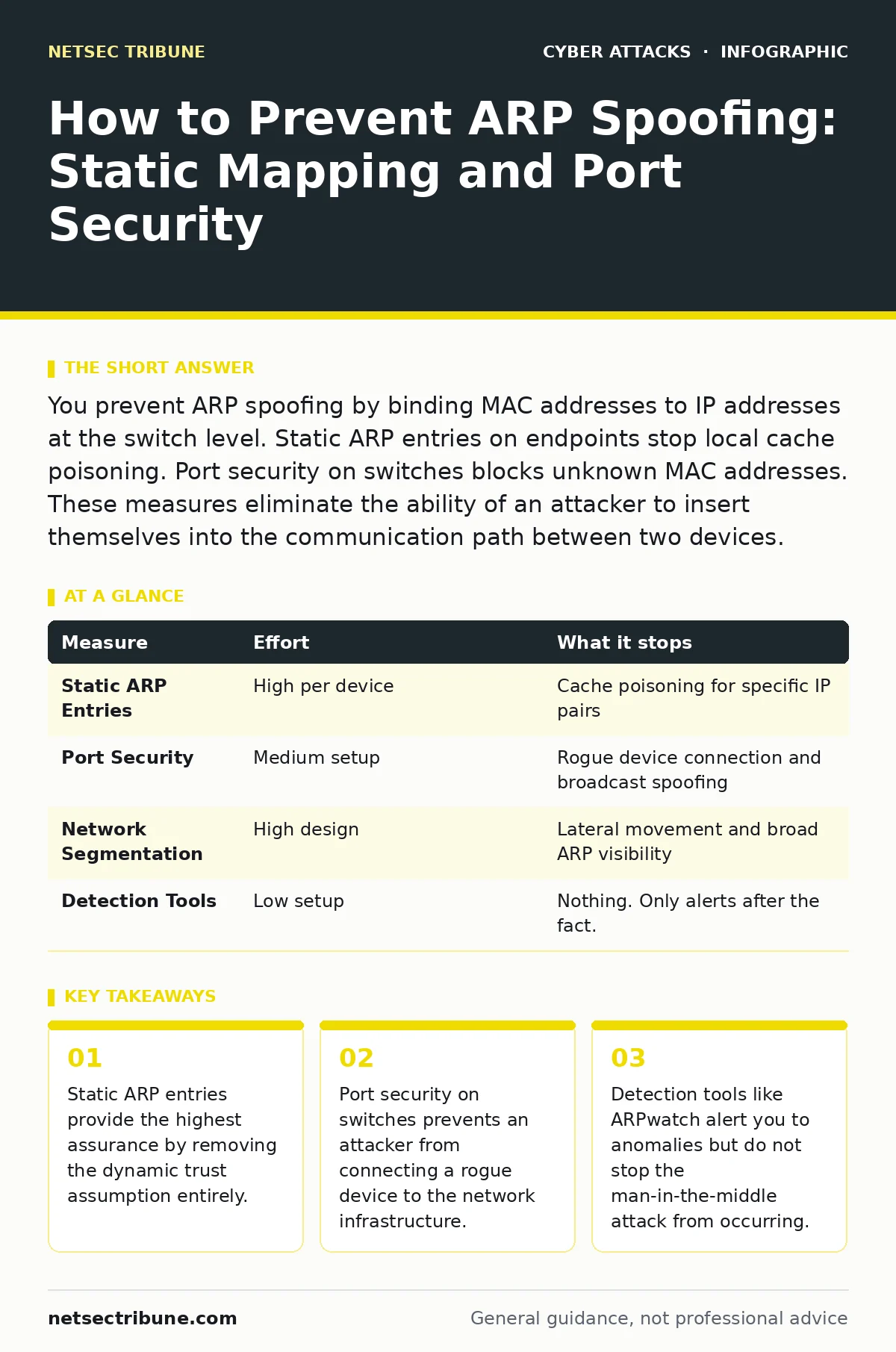
You prevent ARP spoofing by binding MAC addresses to IP addresses at the switch level. Static ARP entries on endpoints stop local cache poisoning. Port security on switches blocks unknown MAC addresses. These measures eliminate the ability of an attacker to insert themselves into the communication path between two devices.
Why Dynamic ARP Fails in Flat Networks
Address Resolution Protocol (ARP) maps IP addresses to MAC addresses on local networks. The protocol assumes every device on the segment is honest. When a device needs to communicate with another, it broadcasts a request asking for the MAC address associated with a specific IP. Any device can reply. An attacker sends a forged reply claiming to own the IP of the gateway or a victim. The victim updates its ARP cache and sends traffic to the attacker. This is ARP spoofing. It turns a local network segment into a wiretap.
The protocol has no authentication. It trusts the first answer it receives. It does not verify if the sender actually owns the IP address. This design flaw exists because ARP was created for trusted, isolated environments. Modern networks rarely offer that isolation. Without segmentation, every device can talk to every other device. This increases the attack surface for ARP spoofing. You must treat the local link layer as untrusted.
How to Prevent ARP Spoofing with Static Entries
You prevent ARP spoofing most effectively by removing the dynamic nature of the protocol. Static ARP entries map an IP address to a specific MAC address permanently. The operating system does not accept updates for that entry. An attacker cannot overwrite the mapping because the system ignores incoming ARP replies for that IP. This method stops cache poisoning at the endpoint level. It requires manual configuration on every device. It does not scale well for large networks. It is ideal for critical servers, printers, and gateway interfaces.
Imagine a financial server that must only talk to a specific database. You configure a static ARP entry on the server for the database IP. An attacker plugs into the same switch and sends forged ARP replies. The server ignores them. The traffic flows directly to the database MAC address. The attacker sees nothing. This measure is low cost and high assurance. It removes the risk entirely for those specific pairs. You must update the entries if hardware changes. This is the primary trade-off.
Switch Port Security Stops Rogue Devices
Switches provide a stronger control point than individual endpoints. Port security restricts the number of MAC addresses allowed on a switch port. You configure the port to accept only one or two specific MAC addresses. If a device with an unknown MAC address connects, the switch shuts down the port or drops the traffic. This prevents an attacker from connecting a laptop to a wall jack and launching an ARP spoofing campaign. It enforces physical access control at the network edge.
This measure stops the attacker from joining the segment. It does not stop an insider with a valid MAC address from spoofing others. You must combine port security with other controls. Port security requires managed switches. Unmanaged switches cannot enforce these rules. Most enterprise networks use managed switches. Configuring port security involves identifying legitimate MAC addresses for each port. This is a one-time setup cost. It provides continuous protection without endpoint configuration.
| Measure | Effort | What it stops |
|---|---|---|
| Static ARP Entries | High per device | Cache poisoning for specific IP pairs |
| Port Security | Medium setup | Rogue device connection and broadcast spoofing |
| Network Segmentation | High design | Lateral movement and broad ARP visibility |
| Detection Tools | Low setup | Nothing. Only alerts after the fact. |
Network Segmentation Reduces Blast Radius
Segmentation divides a large network into smaller subnets. Each subnet has its own broadcast domain. ARP requests do not cross subnet boundaries. An attacker on one subnet cannot ARP spoof a device on another subnet. This limits the number of victims an attacker can reach. It also limits the attacker's ability to intercept gateway traffic for other segments. You use VLANs (Virtual Local Area Networks) to create these segments.
Segmentation does not prevent ARP spoofing within a single VLAN. It reduces the impact. If an attacker spoofs traffic in the marketing VLAN, they cannot intercept traffic in the executive VLAN. This containment is vital for risk management. You must route traffic between VLANs through a firewall or router. This adds a layer of inspection. It slows down lateral movement. It forces attackers to compromise multiple segments to achieve a broad man-in-the-middle position.
What Does Not Work on Its Own
Many teams rely on detection tools to handle ARP spoofing. Tools like ARPwatch monitor ARP traffic and alert on changes. They log when a MAC address changes for an IP. This tells you an attack is happening. It does not stop the attack. The traffic is already being redirected. The attacker has already captured the data. Detection is reactive. Prevention is proactive. You cannot rely on alerts to secure sensitive communications.
Another common mistake is trusting encrypted traffic to solve the problem. TLS (Transport Layer Security) encrypts data between applications. It does not protect the ARP layer. ARP spoofing can still redirect traffic. The attacker can perform a man-in-the-middle attack. They can intercept the TLS handshake. They can present a fraudulent certificate. If the client does not validate the certificate properly, the attacker decrypts the traffic. Encryption hides the content but not the flow. It does not prevent the redirection.
See also: Lateral Movement in Cybersecurity: Definition and Detection · DDoS Protection Explained: How Traffic Shaping Stops Floods
The Hidden Cost of False Assumptions
Security teams often assume that because they use a firewall, they are safe. Firewalls operate at higher layers of the network stack. They inspect packets based on IP and port. They do not inspect ARP packets. ARP is a link-layer protocol. It exists below the firewall. The firewall never sees the ARP spoofing. The traffic is already misdirected before it reaches the firewall. This is a common blind spot. You must secure the layer where the attack occurs.
Another assumption is that wireless networks are safe. Wireless networks use encryption like WPA2. This protects the air interface. It does not protect the wired segment behind the access point. Once a client connects to the Wi-Fi, it joins the wired broadcast domain. It can ARP spoof other devices on that VLAN. Wireless security does not equal wired security. You must apply the same ARP protections to wireless clients as you do to wired devices.
Closing Checklist for Immediate Action
You need to implement controls that remove the trust assumption. Start with the highest risk assets. Then expand to the broader network. These steps provide immediate risk reduction. They do not require expensive new hardware. They require configuration changes.
- Configure static ARP entries on all critical servers for their default gateways.
- Enable port security on all switch ports that connect to end-user devices.
- Review VLAN assignments to ensure sensitive systems are not on general user segments.
Implementing these measures stops the most common ARP spoofing attacks. It forces attackers to find more complex entry points. It reduces the likelihood of successful man-in-the-middle interception. It aligns your network configuration with the principle of least privilege. You treat every local connection as potentially hostile.
Key takeaways
- Static ARP entries provide the highest assurance by removing the dynamic trust assumption entirely.
- Port security on switches prevents an attacker from connecting a rogue device to the network infrastructure.
- Detection tools like ARPwatch alert you to anomalies but do not stop the man-in-the-middle attack from occurring.
Frequently asked questions
Can I prevent ARP spoofing on Windows without admin rights?
No. Modifying ARP tables requires administrative privileges. You cannot set static ARP entries without root or admin access. You must rely on network-level controls or use a host-based firewall to block suspicious traffic.
Does disabling IPv6 stop ARP spoofing?
No. IPv6 uses Neighbor Discovery Protocol (NDP) instead of ARP. NDP has similar trust assumptions. It is vulnerable to Neighbor Discovery spoofing. You must secure IPv6 networks with the same rigor as IPv4 networks.
How do I detect if I am currently being ARP spoofed?
Compare the MAC address in your ARP table with the expected MAC address. Use tools like Wireshark to monitor ARP traffic. Look for duplicate IP claims or unexpected MAC changes. However, detection does not stop the attack.
Is ARP spoofing a legal activity?
No. Intercepting network traffic without authorization violates computer fraud laws in most jurisdictions. It is considered unauthorized access and interception of communications. BOTTOM LINE: Static ARP entries and port security remove the attack vector by eliminating dynamic trust. Configure static mappings for critical infrastructure today to stop cache poisoning at the source.
How this guide was produced: written by the NetSec Tribune editorial team with AI assistance, checked against the public references listed below, and reviewed when the facts change. See our editorial policy or report an error.